Vincent Karaca
Founder & Master Installer
Commercial Flooring Options for PA & NJ Businesses
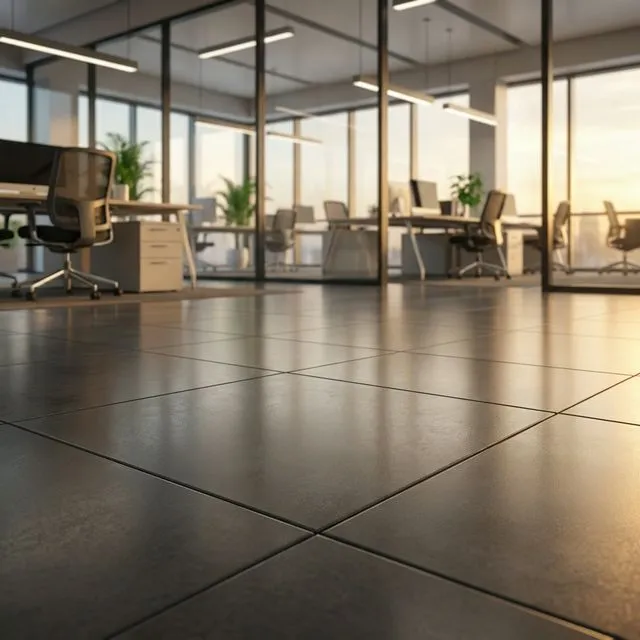
If you run a business in Pennsylvania or New Jersey and you need new flooring, the process is nothing like picking out hardwood for your living room. Commercial flooring has to meet building codes, survive abuse that would destroy residential products in months, and get installed without shutting your operation down for a week. The stakes are higher, the specs are tighter, and the wrong choice costs real money.
I am Vincent Karaca, and I have been running VM Power Flooring since 2003. We are NWFA and CFI certified, we have a team of 35+ professionals, and we have completed more than 4,000+ projects across theLehigh Valley, Bucks County, Bergen County, Passaic County, and everywhere in between. A significant and growing portion of our work is commercial — restaurants, medical offices, retail stores, corporate offices, apartment complexes, and data centers. We also install raised access flooring for server rooms and mission-critical facilities.
This guide covers what you actually need to know when selecting and installing commercial flooring in our part of the country. No filler, no sales pitch. Just the specs, the products, the costs, and the scheduling realities.
Commercial vs. Residential Flooring: Why It's a Different Game
The fundamental difference between commercial and residential flooring is not aesthetics — it is engineering. Commercial flooring has to meet performance benchmarks that residential products are never designed for. When a property manager in Paramus asks us why they cannot just use the same LVP they put in their house, this is what we explain.
Wear layer thickness. Residential LVP typically has a 6-mil to 20-mil wear layer. Commercial-grade LVP starts at 20 mil and goes up to 40 mil. That wear layer is what stands between your floor and every chair leg, high heel, dolly wheel, and piece of grit that gets dragged across it. In a retail store that sees 500 people a day, a 12-mil wear layer will be visibly damaged within a year. A 28-mil commercial product will still look sharp after five.
Fire ratings. Commercial spaces must meet ASTM E648 (Critical Radiant Flux) requirements. Most commercial buildings require a Class 1 rating, which means the flooring must withstand a critical radiant flux of 0.45 watts per square centimeter or higher. Residential products are not tested to this standard. Install a residential floor in a commercial space and you may fail your fire inspection — and your insurance company will not be happy either.
Slip resistance. OSHA and ADA both mandate minimum slip resistance for commercial floors. The ANSI A326.3 standard requires a Dynamic Coefficient of Friction (DCOF) of at least 0.42 for level interior surfaces, and the ADA recommends a static coefficient of friction of 0.6 or higher. Residential flooring manufacturers rarely publish these numbers because they are not required to. Commercial products are tested and rated specifically for this.
Dimensional stability and indentation resistance. Commercial floors deal with rolling loads — carts, chairs, equipment on casters. Products need to meet ASTM F1914 for residual indentation. A residential plank that dents permanently under an office chair will not survive six months in a Lehigh Valley call center.
The good news is that commercial products have come a long way in terms of design. Mannington Commercial, Shaw Contract, and Armstrong all make commercial-grade products that look every bit as good as their residential counterparts. You do not have to sacrifice aesthetics for performance anymore. You just have to know what to specify.
Best Flooring for Restaurants and Food Service
Restaurant flooring is one of the most demanding applications we deal with. The floor has to handle constant spills, grease, dropped dishes, heavy foot traffic from staff moving at speed, rolling carts, and aggressive cleaning chemicals — often all on the same Tuesday night. We have done flooring for restaurants from Bethlehem to Bergen County, and the requirements are consistent: it has to be slip-resistant, waterproof, easy to clean, and tough enough to survive a commercial kitchen.
Kitchen and back-of-house areas. The kitchen is non-negotiable — you need commercial sheet vinyl or quarry tile. Sheet vinyl (products like Armstrong Medintech or Mannington BioSpec) gives you a seamless, waterproof surface with excellent slip resistance when wet. It typically runs $4 to $7 per square foot installed. Quarry tile is the traditional choice and it is nearly indestructible, but it is harder on your staff's feet and joints during a 10-hour shift. Quarry tile runs $8 to $12 per square foot installed.
Both options need to meet a DCOF of at least 0.42 — and honestly, for a commercial kitchen, you want 0.50 or higher. Grease, water, and flour on a kitchen floor create conditions that will expose any weakness in your slip resistance. We strongly recommend products that have been tested under ANSI A326.3 with contaminants, not just in dry conditions.
Dining room and front-of-house. This is where you get more freedom. Commercial-grade LVP with a 28-mil wear layer is our most popular recommendation for restaurant dining rooms. It looks like hardwood or natural stone, handles spills without damage, and cleans easily. Shaw Contract's Resilient line and Mannington Commercial's Amtico collection both offer stunning wood and stone visuals in products rated for heavy commercial use. Expect $6 to $9 per square foot installed.
Porcelain tile is the other strong option for dining rooms. A wood-look porcelain in a large format (8x48 or 10x60) gives you the appearance of a plank floor with the durability of ceramic. It handles dropped plates, chair scrapes, and wet mopping without flinching. The install cost is higher — $10 to $14 per square foot — but the lifespan is effectively indefinite if you choose PEI Class 5 products.
One more thing for restaurant owners: check your local health department requirements. New Jersey and Pennsylvania both have sanitary codes that specify flooring in food prep areas must be smooth, nonabsorbent, and easily cleanable. Porous materials like natural stone and unglazed ceramic are usually not permitted in commercial kitchens without a sealed finish.
Medical and Dental Office Flooring
Medical and dental offices in New Jersey and eastern Pennsylvania have flooring requirements that go beyond normal commercial specs. We have done work for dental practices in Morristown, urgent care facilities in Allentown, and medical office suites throughout Bergen County. The flooring needs to support infection control, handle rolling equipment, meet ADA requirements for wheelchair and walker accessibility, and still create a welcoming atmosphere for patients.
Treatment rooms and clinical areas. The standard here is commercial sheet vinyl or luxury vinyl tile (LVT) with heat-welded seams. Heat welding creates a completely sealed, monolithic surface with no gaps for bacteria, fluids, or contaminants to penetrate. Armstrong's Medintech and Mannington Commercial's BioSpec are industry-standard products for healthcare. Both offer antimicrobial surface treatments and meet ASTM F1861 Type II requirements for rubber sheet flooring.
These products typically run $5 to $8 per square foot installed with heat-welded seams. That is more than standard glue-down vinyl, but the infection control benefits are worth every penny. A dental office that opts for cheaper flooring with standard seams is creating a potential vector for cross-contamination — and inspectors notice.
Waiting rooms and reception areas. Here you have more flexibility to focus on aesthetics while still meeting commercial standards. Commercial LVP in a wood or stone look creates a warm, non-clinical feel that helps patients relax. We installed Mannington Commercial Amtico throughout a 3,500-square-foot dental practice in Easton last year — a light oak visual in the waiting room and corridors, with heat-welded sheet vinyl in the treatment rooms. The result was a space that felt more like a spa than a dental office.
Radiology and imaging rooms. These require special attention. Heavy equipment like MRI machines and X-ray units generate enormous point loads, and the flooring must handle them without indentation or damage. Conductive or static-dissipative flooring may also be required depending on the equipment. Armstrong's SDT (Static Dissipative Tile) is a common specification for imaging suites. This is a specialty product that runs $8 to $12 per square foot installed, but it is non-negotiable for sensitive equipment areas.
ADA compliance is especially critical in medical settings. Every threshold, transition strip, and change in flooring height must meet the tolerances we discuss in the ADA section below. Patients in wheelchairs, using walkers, or recovering from procedures need floors that are completely stable and free of trip hazards. We pay close attention to this in every medical install we do.
Retail Store and Showroom Flooring
If you operate a retail space — whether it is a boutique on Main Street in Bethlehem, a showroom in the Lehigh Valley industrial parks, or a store in one of the Paramus retail corridors — your flooring does double duty. It has to survive heavy foot traffic and rolling loads while also contributing to your brand experience. The floor is the largest visible surface in most retail environments. Customers notice it, even if they do not realize they are noticing it.
High-traffic retail (big box, grocery, high-volume stores). Polished concrete is the workhorse of high-volume retail. It is virtually indestructible, easy to maintain, and costs $3 to $7 per square foot to grind and polish an existing concrete slab. The downside is limited aesthetic options — you are working with concrete, so the color palette runs from gray to slightly warmer gray. For warehouse-style retail, hardware stores, and grocery, that works fine. Large-format porcelain tile is the step up, running $9 to $14 per square foot installed but offering unlimited design options.
Boutique and specialty retail. This is where commercial LVP and high-end porcelain tile shine. A fashion boutique or jewelry store needs a floor that communicates quality. We have installed wide-plank commercial LVP (Shaw Contract's Patcraft line) in several retail spaces in Bergen County. The product has a 28-mil wear layer that handles foot traffic and shopping cart wheels, but it looks like hand-scraped European oak. Installed cost runs $7 to $9 per square foot.
For high-end showrooms — car dealerships, furniture stores, design studios — large-format polished porcelain creates a dramatic effect. We recently did a 6,000-square-foot showroom floor near Allentown using 24x48 polished porcelain. The cost was $12 per square foot installed, but the visual impact was immediate. The owner told us customers comment on the floor constantly.
The rolling load question. Every retail floor needs to handle rolling loads — shopping carts, hand trucks, pallet jacks in the back room. The relevant spec here is ASTM F2055, which tests for damage from caster chairs and rolling loads. Any product you specify should be rated for rolling loads of at least 250 pounds. Most commercial-grade LVP and all porcelain tile meet this. Budget LVP and laminate do not. We have seen retail stores in NJ that installed residential-grade LVP to save money and had visible wear paths within eight months.
Office and Corporate Space Flooring
Office flooring in the Lehigh Valley and northern New Jersey market has shifted dramatically in the last five years. The days of wall-to-wall commercial broadloom carpet in every office are fading. We are seeing a major move toward carpet tile, commercial LVP, and hybrid approaches that mix hard surface in common areas with carpet tile in workstation zones.
Carpet tile. This is still the most popular choice for office spaces, and for good reason. Carpet tile (also called modular carpet) comes in 24x24 or 18x36 planks that install over virtually any subfloor with minimal prep. The real advantage is maintenance — if a section gets stained or worn, you replace individual tiles instead of recarpeting the whole room. Shaw Contract's EcoWorx and Mannington Commercial's Sketch lines are two products we install frequently in office environments.
Commercial carpet tile runs $4 to $8 per square foot installed. The lower end gets you a solid, no-frills product suitable for call centers and back-office areas. The higher end buys you premium textures, patterns, and backing systems. We did a 12,000-square-foot carpet tile installation for an insurance company in the Lehigh Valley office parks — Shaw Contract's carbon-neutral tiles throughout open office areas, with a different pattern in conference rooms for visual distinction. Total project came in at $5.50 per square foot, which is competitive for the quality of product.
Commercial LVP in offices. The trend toward hard surface in offices accelerated during COVID when businesses started thinking more seriously about cleaning and sanitization. Commercial LVP is easier to disinfect than carpet, does not harbor allergens, and holds up well to rolling office chairs — provided you select a product with adequate indentation resistance. Look for products tested to ASTM F1914 with a maximum residual indentation of 0.005 inches or less.
One consideration with LVP in large offices: acoustics. Hard surface flooring in a 10,000-square-foot open office creates echo and noise issues that carpet naturally absorbs. If you go with LVP, budget for acoustic solutions — ceiling baffles, desk dividers, or an acoustic underlayment (which adds $0.75 to $1.50 per square foot). We always flag this for our office clients because they rarely think about it until the floor is down and the space sounds like a gymnasium.
Raised access flooring is another option we install in corporate environments, particularly in server rooms, data centers, and modern open-plan offices that need flexible cable management. Raised access floor panels sit on adjustable pedestals above the structural slab, creating a plenum for power, data, and HVAC distribution. This is standard in data centers but increasingly common in high-end office buildouts where companies want the flexibility to reconfigure their space without tearing up the floor. We are one of the few flooring contractors in the PA and NJ region with real experience installing raised access systems.
Multi-Family and Apartment Turnover Flooring
Property managers and apartment owners across eastern PA and northern NJ are a big part of our business. When you manage 50, 100, or 500 units, flooring decisions are driven by a completely different set of priorities than a single homeowner faces. You need products that are affordable, fast to install, durable enough to survive tenants, and attractive enough to command market-rate rents. We have done unit turnovers for property management companies from Allentown to Morristown, and the math always comes down to the same equation: cost per square foot versus years of service life.
The case for commercial-grade LVP in apartments. This is what we recommend for most apartment turnovers, and here is why. A quality commercial LVP with a 20-mil wear layer costs $5 to $7 per square foot installed. It is waterproof, scratch-resistant, and can be installed over most existing subfloors without extensive prep. In a standard 800-square-foot one-bedroom apartment, we can complete a full LVP install in one day, which means your vacancy window stays short.
Compare that to hardwood at $8 to $12 per square foot that every tenant's dog will scratch up, or carpet at $3 to $5 per square foot that needs replacement every 3 to 4 years in rental units. Over a 10-year period, the LVP wins. We did the analysis for a property management company in Bethlehem that manages 120 units: switching from carpet to mid-range commercial LVP increased their per-unit flooring cost by about $1,200 upfront but eliminated carpet replacements at every turnover, saving them roughly $3,000 per unit over ten years.
Sound transmission in multi-family. This is a building code issue, not just a comfort preference. Most multi-family buildings require a minimum IIC (Impact Insulation Class) rating of 50 or higher between floors. Many LVP products do not meet this on their own — they need an acoustic underlayment rated for multi-family use. Products like Mannington's Quantum Guard or a separate cork underlayment can bring the assembly into compliance. Without it, you will get noise complaints from downstairs tenants and potentially fail inspection. We always verify the IIC requirements with the local building department before specifying products for multi-family projects.
Speed matters in turnovers. Every day a unit sits vacant is lost revenue. Our crews can install LVP in a standard apartment unit in a single day. We have done back-to-back turnovers for apartment complexes where we completed three to four units per week with a two-person crew. If we are coordinating with painters and cleaning crews, we can have a unit market-ready in 48 to 72 hours from the time flooring starts.
ADA Compliance and Safety Requirements
Every commercial flooring project in Pennsylvania and New Jersey must comply with the Americans with Disabilities Act. This is not optional and it is not something you figure out after the floor is installed. ADA compliance needs to be part of the specification from day one. We have seen businesses in our area get hit with complaints and retrofit costs because their flooring installer did not understand or did not follow ADA guidelines. That does not happen on our projects.
Slip resistance requirements. The ADA requires that floor surfaces be stable, firm, and slip-resistant. The specific benchmark referenced by most building codes is a static coefficient of friction (SCOF) of 0.6 for level surfaces and 0.8 for ramps, as measured by ASTM C1028 or ASTM D2047. The newer ANSI A326.3 standard uses Dynamic Coefficient of Friction (DCOF) and requires a minimum of 0.42 for level interior surfaces. Both metrics may apply depending on your local jurisdiction and inspector.
In practical terms, this means you need to check the DCOF rating on any product you are considering. Polished porcelain and high-gloss finishes can be problematic — they may look beautiful but fail the slip resistance test, especially when wet. We always recommend matte or textured finishes for commercial environments. If a client in NJ insists on a polished floor, we discuss the liability implications and may recommend an anti-slip treatment that can be applied after installation.
Transition and threshold requirements. This is where a lot of commercial floors fail ADA. The rules are specific:
- Level changes up to 1/4 inch may be vertical (untreated).
- Level changes between 1/4 inch and 1/2 inch must be beveled at a maximum slope of 1:2.
- Level changes greater than 1/2 inch must be treated as a ramp, with a maximum slope of 1:12, handrails, and edge protection.
Every doorway, every transition between different flooring materials, and every threshold in your commercial space needs to meet these tolerances. This is particularly relevant when you are renovating and tying new flooring into existing floors at different heights. We measure and plan every transition point during our site survey, before any material is ordered or installed.
Carpet specifications under ADA. If you are using carpet in a commercial space — common in offices, hotels, and conference rooms — the ADA limits pile height to 1/2 inch maximum. The carpet must be securely attached (no loose-lay), and exposed edges must have trim that is fastened to the floor surface and does not create a trip hazard. Loop pile carpet generally meets ADA requirements more easily than cut pile because it provides a firmer surface for wheelchair wheels and walker tips.
Door clearance. This one catches people off guard. Adding new flooring can raise the floor height, which reduces the clearance under doors. ADA requires a minimum maneuvering clearance at doors, and if your new floor reduces that clearance below the minimum, the doors need to be trimmed or rehung. We factor this into every commercial project and flag it during the estimate so there are no surprises on installation day.
Scheduling Commercial Installs: Minimizing Downtime
This is the section that matters most to business owners, and it is where a lot of flooring companies fall short. Residential installers show up at 8 AM, work until 4 PM, and come back tomorrow. That schedule does not work when you run a restaurant that is open for dinner, a medical practice that sees patients five days a week, or a retail store that cannot afford to close during the holiday season. Commercial flooring installation requires scheduling discipline that most residential-focused companies simply do not have.
After-hours and weekend installation. The majority of our commercial projects in NJ and the Lehigh Valley are done outside of normal business hours. We run evening shifts (6 PM to 2 AM) and weekend shifts for businesses that cannot close. A restaurant in Morristown that needed new flooring in the dining room and bar area? We started after the last customer left at 11 PM and wrapped up before the lunch prep crew arrived at 9 AM, four nights in a row. A dental office in Bergen County? We did the entire install over a long weekend — Friday evening through Monday morning.
After-hours work does carry a premium, typically 10 to 20 percent above standard daytime rates. But compare that to the revenue you lose by closing your doors for a week. For most businesses, the after-hours premium is a fraction of the cost of lost sales and disrupted operations.
Phased installation. For larger spaces that cannot shut down entirely, we plan phased installs where we complete one section while the rest of the business operates normally. A 10,000-square-foot retail store might be done in four phases over four weeks, with temporary barriers and walkways directing customer traffic around the active work zone. We did exactly this for a retail location near Paramus — installed new commercial LVP in quadrants, moving fixtures and displays as each section completed. The store never closed and the manager estimated they lost less than 5 percent of normal foot traffic during the project.
Material staging and logistics. Commercial projects require more planning than residential ones. Materials for a 5,000-square-foot office install do not fit in the back of a pickup truck. We coordinate deliveries to arrive on a schedule that matches the installation phases. For occupied buildings with limited staging space, we sometimes deliver materials in batches — enough for two or three days of work at a time. We also coordinate with building management on freight elevator access, loading dock schedules, and any building-specific rules about noise hours or contractor insurance requirements.
Subfloor preparation timeline. This is the variable that throws off more commercial schedules than anything else. If the existing subfloor needs leveling compound, that compound needs time to cure — typically 24 to 48 hours depending on the product and thickness. Moisture mitigation systems, if required, can add another day or two. We test every commercial subfloor for moisture (using ASTM F2170 relative humidity testing and ASTM F1869 calcium chloride testing) during the site survey so we can account for mitigation in the project timeline. Finding out you need moisture mitigation after the project has started is a schedule killer.
Coordination with other trades. Commercial flooring rarely happens in isolation. It is usually part of a larger buildout or renovation that involves electricians, plumbers, painters, HVAC techs, and general contractors. We are used to working within a broader construction schedule and coordinating with other trades. The critical rule is that flooring goes in last (or close to last) — after painting, after ceiling work, after any overhead MEP work that could damage a finished floor. When we are brought into the scheduling conversation early, we can prevent delays. When we are called in at the last minute to install flooring around other trades still working overhead, it never goes as smoothly.
The Bottom Line for PA and NJ Business Owners
Commercial flooring is not a commodity purchase. The product selection, the specifications, the ADA compliance, the scheduling — all of it requires a contractor who understands the commercial environment. We have been doing this across Pennsylvania and New Jersey since 2003 and we bring the same level of professionalism to a 500-square-foot dental office as we do to a 20,000-square-foot retail buildout.
Whether you need commercial LVP for a restaurant, carpet tile for a corporate office, porcelain tile for a medical facility, or raised access flooring for a data center, we have the certifications, the crew, and the experience to deliver a finished product that meets every spec and every deadline.
Contact us for a free commercial site survey and proposal. We will walk your space, discuss your requirements, test your subfloor, and give you a detailed quote with a realistic timeline — no surprises, no hidden costs.
About the Author
Founder & Master Installer
Certified: NWFA, CFI
Vincent started refinishing hardwood floors in his early twenties, working alongside his father on weekends between construction jobs in the Lehigh Valley. By 2012, he had enough repeat customers to g...
You Might Also Like
How Much Does Flooring Installation Cost in 2026? Complete Price Guide
Tired of vague price ranges from sites that have never swung a hammer? Here are real, local flooring costs pulled from p...
Read: How Much Does Flooring Installation Cost… Cost GuideWhy Your Flooring Quote Varies: What Goes Into Pricing
You called three companies and got three wildly different numbers. Before you pick the cheapest one, let us show you wha...
Read: Why Your Flooring Quote Varies: What Goe… Buying GuideBest Flooring Options for Kitchens, Bathrooms & Basements
We've pulled up enough warped hardwood and moldy carpet from basements to know exactly which flooring belongs in wet are...
Read: Best Flooring Options for Kitchens, Bath…