Vincent Karaca
Founder & Master Installer
Hardwood vs. Luxury Vinyl Plank: Which Is Better for Your Home?
Why We Wrote This Guide (And Who It's For)
We get asked this question at least three times a week. A homeowner stands in their living room, samples from two different stores fanned out on the floor, and asks us: "So what would you do?"
After installing over 2,000 floors across the Lehigh Valley and northern New Jersey, we've stopped giving the safe answer. You can find "it depends" on every other flooring blog on the internet. This guide is what we actually tell homeowners when they pin us down for a real opinion.
This is for you if you're choosing between solid or engineered hardwood and luxury vinyl plank (LVP) for your home. Maybe you're renovating a colonial in Bethlehem. Maybe you just bought a split-level in Parsippany and the carpet has to go. Maybe you're building new in Easton and your builder is pushing one option over the other.
Whatever the situation, we're going to walk through this the same way we do in person — with actual numbers from local projects, honest opinions, and none of that both-sides-are-great hedging that helps nobody make a decision.
The Look and Feel — Let's Be Honest
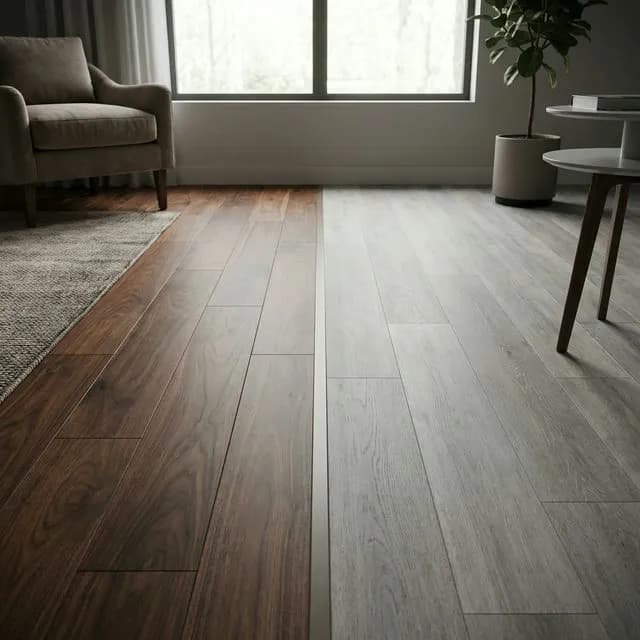
Look, we love LVP. We install a ton of it. But if someone tells you it looks identical to hardwood, they're either selling you something or they haven't spent much time around real wood floors.
Hardwood has a warmth and depth that vinyl can't replicate. The grain variation, the way light plays across a white oak plank, the subtle imperfections that remind you it's an actual piece of a tree — it's different. You notice it when you walk into a room. There's a reason people say "wow" when they see freshly installed 5-inch white oak with a matte finish. We did a whole first floor in a 1920s Bethlehem row home last fall — wide plank white oak, natural finish — and the homeowner's mother literally teared up when she saw it. You don't get that reaction from vinyl.
That said, LVP has come a long way. The embossed-in-register (EIR) products we install now have texture that lines up with the printed grain pattern. From standing height, in normal lighting, most people genuinely cannot tell. A couple in Bergen Countyasked us to install LVP in their open-concept main floor last spring, and when their neighbors came over for a housewarming, every single person assumed it was real wood. They told us that story with a big grin.
Here's where it gets more nuanced though. Underfoot, the difference is obvious. Hardwood has a solid, warm feel. It has a little give, a slight resonance when you walk across it. LVP — even the good stuff — feels like you're walking on a firm, slightly plastic surface. It's not unpleasant. But it's different. If you kick off your shoes and walk barefoot across both, you'll know which is which every time.
Our honest take: If aesthetics and feel are your top priority and budget allows, hardwood wins. If you want something that looks 85% as good at 60% of the cost, LVP is remarkable for the price.
One more thing on looks. LVP patterns repeat. Every manufacturer has a set number of unique plank designs — usually between 6 and 12 — and then they cycle. In a small bathroom, nobody notices. In a 400-square-foot open living area, a sharp eye will catch repeating patterns. We stagger boxes during installation to minimize this, but it's worth mentioning. Hardwood? Every single plank is unique. Nature doesn't do copy-paste.
Durability: What Actually Happens After Year One
This is where things get interesting, and where a lot of the internet advice falls apart.
Hardwood is strong. It's been used in homes for centuries. But it scratches. Period. If you have a dog over 40 pounds, kids who drag toys across the floor, or a habit of walking in with gravel on your shoes, your hardwood will show it. We refinished a hickory floor in an Allentown home last March — the family had two labs and three kids under 10. The floor was only four years old and it looked like it had been through a decade of hard living. Hickory is one of the hardest domestic species. Didn't matter.
LVP handles surface abuse better. Period. The wear layer on a quality LVP plank (we recommend 20 mil minimum, 28 mil for busy homes) is designed to resist scratches, scuffs, and stains. We've seen 5-year-old LVP installations in homes with multiple dogs that still look like the day we put them in. That's not something we can say about hardwood under the same conditions.
But — and this is a big but — hardwood can be repaired. LVP cannot. When hardwood gets scratched up, you sand it down and refinish it. Like new. You can do this three to five times over the life of a solid hardwood floor. That means a well-maintained hardwood floor can genuinely last 80+ years. When LVP gets damaged beyond the wear layer, that plank is done. You either replace individual planks (if you saved extras and the color still matches) or you're looking at a full replacement. For more on how these surfaces hold up in wet rooms specifically, check out our guide on the best flooring for kitchens, bathrooms, and basements.
Here's something most articles won't tell you: LVP can dent. Drop a cast iron skillet on hardwood and you'll get a dent. Drop it on LVP and you'll also get a dent — sometimes worse, because the vinyl core compresses and doesn't bounce back. Heavy furniture legs without pads will indent LVP over time. We always recommend felt pads on everything, but it's worth knowing.
| Factor | Hardwood | LVP |
|---|---|---|
| Scratch resistance | Moderate (species-dependent) | High (wear layer protects) |
| Dent resistance | Good (hard species) | Moderate (core can compress) |
| Repairability | Sand & refinish 3-5 times | Replace individual planks only |
| Lifespan | 80-100 years (maintained) | 15-25 years |
| Pet performance | Fair (scratches visible) | Excellent |
| Fading from sunlight | Moderate (changes tone over time) | Low with UV-resistant layer |
Water Resistance — The Deal-Breaker for PA & NJ Homes
If you live in Pennsylvania or New Jersey, water is going to find its way into your home at some point. It's not a matter of if, it's when. Basement seepage in the spring, ice dams in January, a washing machine hose that gives out on a Tuesday afternoon. We deal with water damage calls all year long.
Honestly, LVP wins here and it's not close.
Hardwood and water are enemies. Even engineered hardwood with a plywood core will warp, cup, or buckle with sustained moisture exposure. Last month we pulled up engineered hardwood in a Bethlehem kitchen that had been installed over a concrete slab without a proper moisture barrier. The edges of every plank were curling up. The homeowners had only been in the house for two years. That tear-out and replacement cost them $6,800 for a 180-square-foot kitchen. Painful.
LVP's rigid core is made from stone plastic composite (SPC) or wood plastic composite (WPC). Neither absorbs water. You can leave a puddle on LVP for days and the plank itself won't flinch. We've pulled up LVP from flooded basements in Passaic County, dried the subfloor, and re-installed the same planks. Try that with hardwood.
The one nuance: LVP isn't fully waterproof at the seams. If flood water sits for hours, it can seep between planks and get trapped underneath, causing mold on the subfloor. But in normal residential use — a spilled glass of water, a dog's wet paws, a kid who misses the toilet — it's bulletproof. Hardwood can't touch that.
Real Cost Breakdown (Not Internet Guesses)
We're going to give you real numbers from projects we completed in the last six months across the Lehigh Valley and northern NJ. These include material and labor but not demo of existing flooring (that varies too much by what's currently down).
Hardwood — Installed Cost
- Solid hardwood (3/4" oak, site-finished): $11 to $15 per square foot
- Engineered hardwood (good quality, pre-finished): $9 to $13 per square foot
- Wide plank white oak (7"+, custom finish): $14 to $18 per square foot
A typical 1,200-square-foot first floor in engineered hardwood runs $10,800 to $15,600 installed. We just finished one in Nazareth at $12,400 — 1,200 square feet of 5-inch engineered white oak, pre-finished, glue-down over concrete with moisture barrier.
LVP — Installed Cost
- Mid-range LVP (6mm, 20 mil wear layer): $5.50 to $7.50 per square foot
- Premium LVP (8mm, 28 mil wear layer): $7 to $10 per square foot
- Budget LVP (we don't recommend): $3.50 to $5 per square foot
That same 1,200-square-foot project in premium LVP? $8,400 to $12,000. We did a similar job in an Easton townhouse last month — 1,100 square feet of 7mm SPC with a 28-mil wear layer — for $9,200 installed. The homeowners saved about $4,000 compared to the hardwood quote and were thrilled with the result.
The Hidden Costs People Forget
Material and labor are only part of the picture. Here's what adds up:
- Demolition of old flooring: $1.00 to $2.50 per square foot depending on what's coming up
- Subfloor leveling: $2 to $4 per square foot if your subfloor is uneven (very common in homes built before 1980)
- Transitions and trim: $300 to $800 for a typical whole-floor project
- Furniture moving: Free with our full installation packages, but some companies charge $200+
- Moisture barrier (concrete slabs): $0.50 to $1.25 per square foot
Hardwood also has an ongoing cost that LVP doesn't: refinishing. Budget $3.50 to $5.50 per square foot every 8 to 12 years. For a 1,200-square-foot floor, that's $4,200 to $6,600 each time. Over 30 years, you might refinish two or three times. LVP has zero maintenance cost beyond basic cleaning — but you'll eventually replace it entirely.
Installation: What to Expect on Project Day
We've noticed that homeowners are a lot less stressed when they know what's coming. So here's what a typical installation day looks like for each product.
Hardwood Installation
Hardwood takes longer. That's just the reality. A 1,000-square-foot hardwood installation typically takes our crew 3 to 4 days. If we're doing site-finished (sanding and finishing on-site), add another 2 to 3 days for sanding, staining, and applying polyurethane coats with dry time between each. You won't be able to walk on it or move furniture back for 48 to 72 hours after the final coat.
Hardwood also needs to acclimate. We deliver the material 3 to 5 days before installation and leave it stacked in the room where it'll be installed. The wood needs to adjust to your home's temperature and humidity, or it'll expand or contract after installation. We've seen other companies skip this step. It always catches up with them.
LVP Installation
LVP is faster. Significantly. That same 1,000-square-foot space? Our crew knocks it out in 1 to 2 days. The click-lock system means no glue, no nails, and no dry time. You can walk on it and move furniture back the same day.
Acclimation is shorter too — 24 to 48 hours in most cases. Some manufacturers don't even require it for SPC products because the rigid core is dimensionally stable.
Noise level: Both installations are loud. We use nail guns for hardwood and rubber mallets for LVP. If you work from home, plan to set up somewhere else for the day. We wrote a whole guide on how to prepare your home for installation day that covers the practical stuff — pets, furniture, HVAC settings, all of it.
One thing we hear a lot: "Can't I just install LVP myself?" Technically, yes. The click-lock system is designed for DIY. But in our experience, DIY installations show their mistakes within 6 to 12 months — gaps at walls, planks lifting in doorways, transitions that don't sit right. The material is forgiving but the prep work and detail work still matter. Check our LVP installation services page for what professional installation includes.
Resale Value — What Buyers Actually Care About
This is the section where hardwood has traditionally dominated the conversation. And honestly? It still has an edge. But the gap is closing fast.
Hardwood floors are a known selling point. Real estate agents in the Lehigh Valley tell us that hardwood is one of the top three things buyers mention. It signals quality. It photographs well. It gives a listing that "move-in ready" feel that buyers pay a premium for. National data puts the ROI of hardwood flooring at roughly 70% to 80% of cost recovered at resale.
But here's what's changed. Five years ago, LVP was still seen as "fake wood flooring." Buyers in Bergen County and the Lehigh Valley were skeptical. Today? Most buyers under 45 don't care whether it's real wood or quality LVP — they care whether it looks good and whether they'll have to replace it soon. A real estate agent we work with in Allentown told us she's stopped even mentioning the material type in listings. She just says "wood-look plank flooring" and nobody asks.
That said, there are still clear lines. If you're selling a home above $500K in our market, buyers expect hardwood in the main living areas. If you're selling a $280K starter home or a rental property, quality LVP is the smarter investment. You spend less, it looks great in photos, and buyers won't ding you for it.
Our recommendation for resale: If you plan to sell within 3 to 5 years and your home is in the mid-to-upper price range, hardwood is the safer bet. If you're staying long-term or the home is under $400K, put the savings from LVP toward kitchen or bathroom updates — that's where you'll get more return.
Curious about what's trending in the local market right now? Our 2026 flooring trends post covers what buyers and homeowners in PA and NJ are actually choosing this year.
Room-by-Room Recommendations
Here's the framework we use with every client. Not every room in your home needs the same floor — and honestly, most homes look better with a mix.
Living Room / Great Room
Our pick: Hardwood (if budget allows) or premium LVP. This is the room guests see first and where you spend most of your time. Hardwood gives you the wow factor. But if you have young kids or big dogs, premium LVP keeps its looks longer without the stress. We installed white oak hardwood in a Bethlehem living room last year and LVP in the adjoining family room — the homeowner gets the best of both worlds and the transition between them is clean.
Kitchen
Our pick: LVP, no question. Kitchens see water, grease, dropped jars, and heavy foot traffic. We've pulled up water-damaged hardwood from more kitchens than we can count. The dishwasher leak is the silent killer — it drips for weeks before anyone notices, and by then the hardwood is warped beyond repair. LVP handles all of it without flinching.
Bedrooms
Our pick: Either works great. Bedrooms are low traffic and low moisture. Hardwood feels warm and quiet underfoot with area rugs. LVP with a quality underlayment feels good too and costs less. If you're doing hardwood in the main living area, extending it into bedrooms creates a nice flow. If budget is a factor, this is a good room to save with LVP.
Bathroom
Our pick: LVP or tile. Never hardwood. We say this at every consultation and we'll say it here: do not put hardwood in a bathroom. Not solid, not engineered. The humidity alone will cause problems within a couple of years. LVP works well in half-baths and powder rooms. For full baths with showers, we lean toward tile — but LVP is still a better choice than hardwood.
Basement
Our pick: LVP only. Below-grade spaces have moisture migration through concrete, temperature swings, and occasional water events. Hardwood in a basement is a disaster waiting to happen in our PA and NJ climate. We've done a lot of basement finishes in the Easton and Nazareth area and LVP over a proper moisture barrier is the standard. Read our full guide on the best flooring for basements and wet areas for the details.
Entryway / Mudroom
Our pick: LVP or tile. This is where rock salt, wet boots, and road grime enter your home from November through March. We had a customer in Allentown with beautiful maple hardwood in their entryway. After two winters, the finish was completely destroyed by salt residue. They switched to LVP and haven't thought about it since.
| Room | Hardwood | LVP | Our Pick |
|---|---|---|---|
| Living Room | Excellent | Great | Hardwood (or premium LVP) |
| Kitchen | Risky | Excellent | LVP |
| Bedroom | Excellent | Great | Either |
| Bathroom | No | Good | LVP or tile |
| Basement | No | Excellent | LVP only |
| Entryway | Poor | Excellent | LVP or tile |
Frequently Asked Questions
Can you install LVP over existing hardwood floors?
Yes, in most cases. If your existing hardwood is flat and structurally sound, we can float LVP right over it. We do this pretty regularly in older Allentown homes where the hardwood is beat up but still level. The one catch: it raises your floor height by about a quarter inch, which can affect doors and transitions to other rooms. We always check this during the estimate so there are no surprises.
How long does hardwood last compared to LVP?
Hardwood can last 80 to 100 years if maintained and refinished every 8 to 12 years. LVP typically lasts 15 to 25 years depending on the product quality and foot traffic. But here's the thing — most homeowners renovate or sell before either product reaches its lifespan. So the real question is which one will look and perform better during the time you actually live in the home.
Is LVP really waterproof or just water-resistant?
The planks themselves are waterproof — you can literally soak them and nothing happens. But the seams between planks are the weak point. If water sits in the seams long enough, it can seep underneath and cause mold on the subfloor. That's why we always say LVP is waterproof in normal use (spills, pet accidents, wet feet from the shower) but not submersion-proof. For basements with active water issues, we address drainage first.
Does LVP decrease home value compared to hardwood?
Not as much as people think. Five years ago, yes — buyers saw vinyl and mentally deducted from their offer. Today, high-end LVP is so realistic that most buyers can't tell the difference. In our market (Lehigh Valley and northern NJ), homes with quality LVP in common areas and tile in wet rooms sell just as fast as homes with hardwood. The exception is luxury homes over $600K where buyers expect real hardwood.
Can hardwood floors handle dogs and cats?
Cats are fine — their claws are retractable and lightweight. Dogs are a different story. Large dogs with untrimmed nails will scratch hardwood, period. We've refinished plenty of floors in Nazareth and Easton that looked like a skating rink after a few years with a German Shepherd. If you have big dogs, either commit to area rugs and regular nail trims, choose a harder species like hickory, or go with LVP. We won't sugarcoat it.
What thickness of LVP should I buy?
We recommend a minimum of 6mm total thickness with a wear layer of at least 20 mil for residential use. For high-traffic areas or homes with pets, bump that wear layer to 28 mil. The thicker the wear layer, the longer it resists scratches and dents. Stay away from anything under 5mm — it feels hollow underfoot and telegraphs every subfloor imperfection. We stock products in the 7 to 8mm range with 28 mil wear layers because that's the sweet spot for performance and feel.
Still Not Sure? Let's Talk It Through
Every home is different. The age of your subfloor, your humidity levels, whether you have pets, how long you plan to stay — all of it factors in. We've been doing this across the Lehigh Valley and northern New Jersey for over 15 years, and we genuinely enjoy helping people land on the right choice.
Bring us into the conversation early. We'll look at your space, talk about your priorities, and give you a straight answer — not a sales pitch. Check out our hardwood installation services and LVP installation services for details on what we offer, or reach out for a free estimate. We typically respond the same day.
Explore Our Related Services
About the Author
Founder & Master Installer
Certified: NWFA, CFI
Vincent started refinishing hardwood floors in his early twenties, working alongside his father on weekends between construction jobs in the Lehigh Valley. By 2012, he had enough repeat customers to g...
You Might Also Like
How Much Does Flooring Installation Cost in 2026? Complete Price Guide
Tired of vague price ranges from sites that have never swung a hammer? Here are real, local flooring costs pulled from p...
Read: How Much Does Flooring Installation Cost… Buying GuideBest Flooring Options for Kitchens, Bathrooms & Basements
We've pulled up enough warped hardwood and moldy carpet from basements to know exactly which flooring belongs in wet are...
Read: Best Flooring Options for Kitchens, Bath… TrendsTop Flooring Trends for 2026: What Homeowners Are Choosing
Pinterest boards are one thing. What homeowners actually pick when they're spending real money is another. Here's what w...
Read: Top Flooring Trends for 2026: What Homeo…