5164+ Google Reviews
Raised Access Flooring in Allentown and the Lehigh Valley
Modular floor systems that give you instant access to power, data, and cooling beneath your feet. CISCA-tested panels rated for 1,000–2,500 lb loads, NFPA 75 compliant — installed for Allentown and Lehigh Valley offices and data rooms.
Last updated: April 29, 2026
$20–$100 / sq ft1-3 weeks depending on size and complexityNWFA & CFI Certified
Direct Answer · Raised Access Flooring Pricing & Benchmarks
Raised Access Flooring installation in Allentown, Bethlehem, and the Lehigh Valley typically costs $20 to $100 per sq ft installed, with project turnaround averaging 1-3 weeks depending on size and complexity. VM Power Flooring provides full subfloor prep, precision acclimation, and an NWFA/CFI-certified lifetime craftsmanship warranty.
Raised Access Flooring in Allentown · Flooring contractors in Allentown
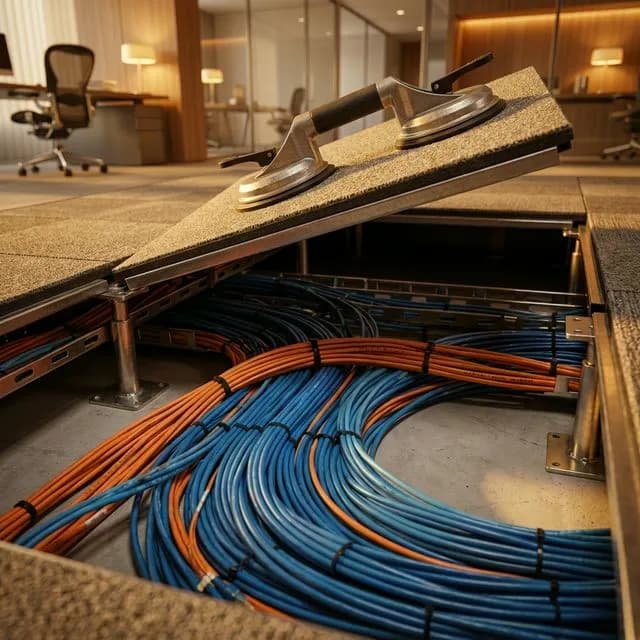
When flooring is the project — new raised access flooring install, refinishing, or a single-room replacement — VM Power Flooring is the flooring-specialist division of the VM Power family. NWFA certified, CFI certified, 4,000+ floors installed across Lehigh Valley and Bergen County NJ, focused exclusively on flooring.
Doing a whole-home renovation that includes flooring (new kitchen + matching hardwood in living room, bathroom + tile, etc.)? Our general-contractor sister brand VM Power Construction coordinates flooring with your other scopes under a single GC contract.
4,000+
Floors Installed
5★
164+ Google Reviews
$2M
Fully Insured
35+
Team Members
What Is Raised Access Flooring?
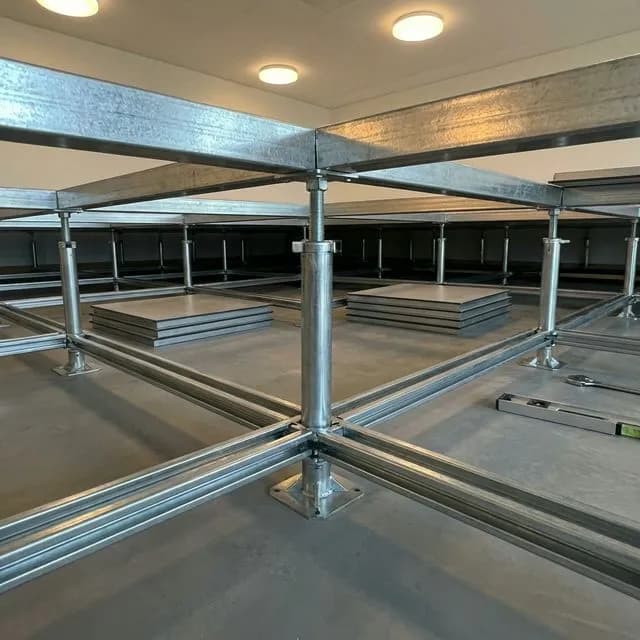
A raised access floor is an elevated structural floor system built above a solid substrate, typically a concrete slab. It creates a hidden void called a plenum between the structural floor and the finished walking surface. This plenum houses mechanical and electrical services and can double as an HVAC air distribution chamber.
The system consists of load-bearing modular panels—typically 600mm × 600mm (approximately 24″ × 24″)—supported by adjustable vertical pedestals, with panels easily removable for access at any point.
First developed in the 1960s by Hiross in Europe to service large mainframe computers, raised access floors came to prominence through IBM installations and BBC studio fit-outs in the 1960s and 1970s. Tate Access Floors, founded in 1963 in the USA, pioneered modular panel systems and integrated airflow designs that remain the industry standard. Today, leading manufacturers like Tate (Kingspan), Haworth, and Lindner produce panels for everything from low-profile office retrofits to high-density data center environments. In the Lehigh Valley, Philadelphia, and business hubs across New Jersey and New York, raised access floors allow companies to adapt layouts rapidly without expensive renovation.
Types of Raised Access Floor Panels
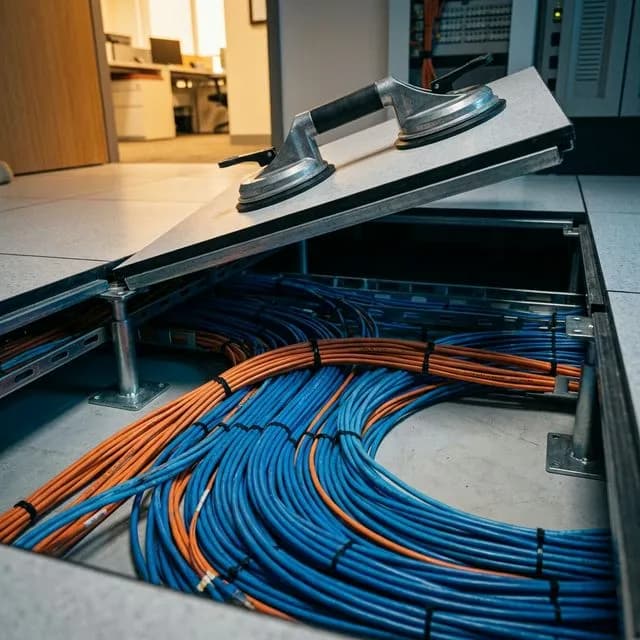
Choosing the right panel type is critical because it determines load capacity, fire performance, acoustic properties, and cost.
Hollow steel panels feature a galvanized steel shell with a hollow core, making them lightweight and easy to handle. They support concentrated loads of 1,000–1,250 lbs and are ideal for general office environments.
Concrete-filled steel panels use the same steel shell filled with cementitious material, delivering superior stability with concentrated loads of 1,250–2,000 lbs—the go-to choice for data centers and high-traffic areas.
Calcium sulphate panels offer the highest load capacity of any panel type, handling concentrated loads of 1,250–2,500 lbs. Their recycled calcium sulphate core sealed with ABS plastic provides excellent fire resistance and acoustic performance, making them the premium choice for server rooms and heavy equipment areas.
Wood core panels feature a composite wood core encased in galvanized steel, offering good sound insulation at a lower price point, though they are susceptible to moisture damage and best suited for dry office environments.
Aluminum die-cast panels are the standard for clean rooms, pharmaceutical labs, and microelectronic manufacturing, providing excellent rolling and concentrated load performance in a lightweight package.
All panel types are available with surface finishes including high-pressure laminate (HPL), PVC, carpet tile, vinyl, rubber, ceramic tile, or bare/perforated configurations for airflow.
Benefits for Commercial & Data Center Environments
The primary advantage of raised access flooring is flexibility. As business needs change, you can reconfigure power and data outlets by swapping floor panels—no trenching, no overhead cable trays, no expensive renovation.
Raised floors enable Underfloor Air Distribution (UFAD), which ASHRAE formally recognizes as superior to overhead systems. Since 2010, ASHRAE 62.1 requires 20% more outside air for overhead systems to match UFAD’s ventilation effectiveness, translating to significant energy savings over the building’s lifetime.
For data centers, the plenum delivers chilled air directly through perforated tiles to server rack intakes, enabling hot aisle/cold aisle containment strategies that prevent hot spots and improve cooling efficiency.
Cable management is dramatically simplified: infrastructure runs through the plenum and is accessible at any point by lifting a panel. Moves, adds, and changes take hours instead of days.
Load distribution is engineered for heavy equipment—CISCA-tested panels support concentrated loads from 1,000 to 2,500+ lbs depending on panel type, with ultimate load ratings of 3× the concentrated load (safety factor of 3:1). Built-in grounding grids and static-dissipative surface finishes protect sensitive electronics from electrostatic discharge (ESD).
Raised floors also contribute to LEED certification through recycled content credits, improved indoor environmental quality, and reduced energy consumption.
Our Installation Process
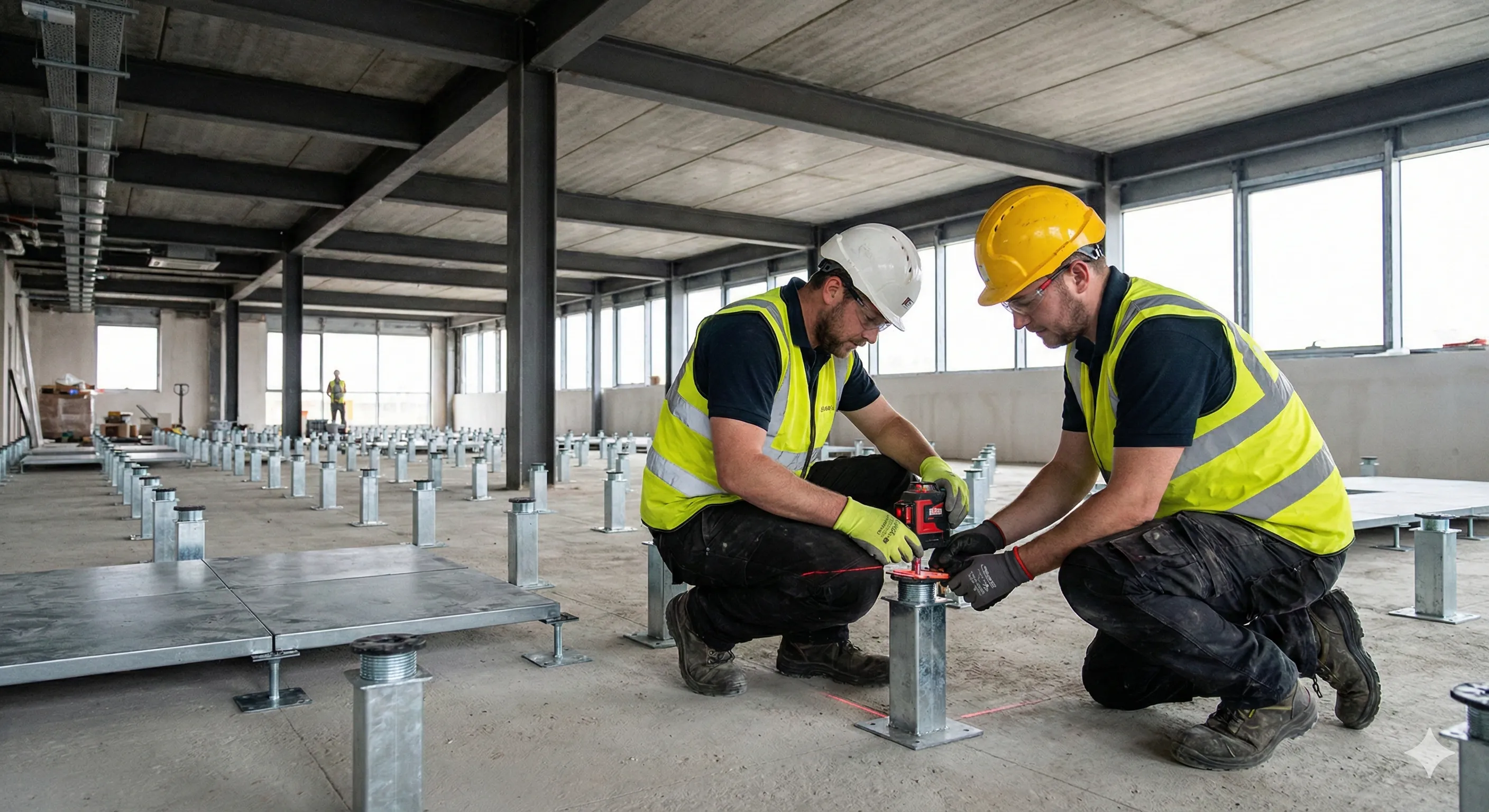
We use two primary installation methods depending on the application.
The stringerless (self-supporting) method is used for low-profile office installations where finished heights are 20 inches or less—panels rest directly on pedestal heads with corner-lock connections, allowing faster installation and lower material cost.
The stringer (reinforced) method is required for data centers and installations above 24 inches, where horizontal stringer members connect pedestals for greater structural integrity and lateral stability. Stringer types include snap-on stringers for lateral support, bolt-on stringers for heavy-duty structural performance, and air plenum stringers with gasket strips that seal panel joints for UFAD efficiency.
Every project begins with a precise laser survey and subfloor assessment. We establish the access floor grid using the 3-4-5 triangulation method to ensure perfect squareness, then install pedestals using heavy-duty adhesive with mechanical fasteners where seismic requirements demand it.
Each pedestal is individually leveled before stringer and panel installation. Our crews install 1,000–2,000 sq ft per day for standard office projects and 500–1,000 sq ft per day for data center builds that require stringer assembly and precision airflow placement. We handle all cutouts for electrical boxes, grommets, and perforated airflow tiles, delivering a turnkey solution from subfloor prep to final finish.
Applications: Data Centers, Offices & Clean Rooms
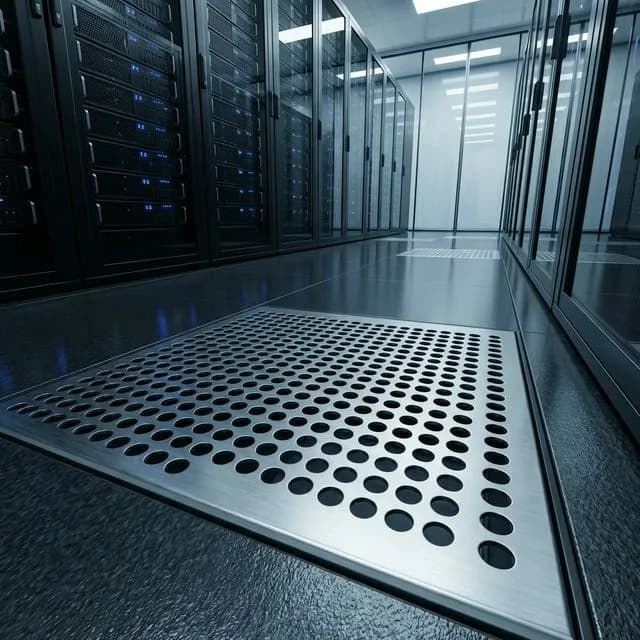
Data centers are the primary application for raised access floors, with plenum heights of 24–48 inches accommodating both cable management and underfloor air distribution. Perforated tiles deliver chilled air in cold aisles while solid panels line hot aisles behind server racks.
The tri-state area is booming—New York leads the Northeast with 149 data centers, New Jersey has 531 MW of existing inventory at just 4% vacancy, and Pennsylvania has 98 data centers with 184 more potentially on the way. New Jersey’s $500 million tax credit program for data center construction is accelerating this growth.
Open-plan offices use low-profile systems (2–6 inches) for retrofit applications, bringing power and data to workstations without power poles or trip hazards—ideal for the 2.3 million sq ft of office space under construction in Manhattan and modernization projects across Philadelphia and Newark.
Clean rooms in pharmaceutical and biotech facilities rely on aluminum die-cast panels for contamination-free environments with precise environmental controls. Command centers, 911 dispatch facilities, trading floors, broadcast studios, casinos, healthcare facilities, and government buildings across PA, NJ, and NY all depend on raised access floors for flexible, accessible infrastructure.
Maintenance, Standards & Compliance
Raised access floors are built for decades of service, but proper maintenance is essential. Daily care includes dust mopping and damp mopping with a mild ammonia-based cleaner—avoid excessive water to prevent HPL delamination.
Vacuum carpet-finished panels three times per week using a vacuum with a static-dissipating rod. Twice a year, clean perforated airflow panels and rotate panels between high and low traffic areas to equalize wear.
Annual professional inspections should cover panel condition, pedestal stability, stringer integrity, grounding connections, and fire suppression integration. Always lift panels with suction cup lifters to protect edges, and never drag heavy equipment across the surface.
CISCA (Ceilings & Interior Systems Construction Association) establishes the authoritative test procedures for concentrated loads, ultimate loads, rolling loads, and pedestal capacity in the United States. NFPA 75 sets the fire protection standard for IT equipment environments, requiring noncombustible structural members and automatic suppression below the raised floor.
ANSI/ESD S20.20 governs electrostatic discharge control with floor surface resistance between 1×10⁶ and 1×10⁹ ohms. All three states base their building codes on the International Building Code (IBC), with Section 805 specifically addressing access floor systems. Pennsylvania enforces the Uniform Construction Code (UCC), New Jersey’s Division of Codes and Standards adds NJ-specific amendments, and New York City maintains its own building code (NYC BC 2022) with additional requirements for commercial construction.
Raised Access Floor Panels and the Site Visit
Raised access floor panels are removable, load-bearing floor tiles that sit on adjustable pedestals above the structural slab. Lifting a panel opens the space underneath for power, data cabling and airflow. Panels are typically 24 in x 24 in (600 mm x 600 mm).
A site visit covers the room dimensions and slab condition, the finished height you need, what will run beneath the floor, and the equipment the panels will carry. We use it to recommend a panel type and put a written scope and quote together.
How Raised Access Floor Installation Works
Five steps to your perfect floor. No surprises, no guesswork.
Site Survey & Engineering
We assess your facility, measure the space, evaluate subfloor conditions, and document load requirements, cabling density, and airflow needs.
System Specification
Our team specifies panel type, pedestal height, stringer configuration, surface finishes, and ESD grounding based on your operational requirements.
Professional Installation
Certified crews install pedestals, stringers, and panels with laser-leveled precision. We handle all cutouts, perforated tiles, and grounding connections.
Commissioning & Verification
We test panel seating, pedestal stability, grounding resistance, and airflow tile placement. You walk the floor with us before sign-off.
Maintenance Planning
We deliver a maintenance schedule covering panel rotation, pedestal inspection, grounding verification, and airflow cleaning intervals.
Why Choose VM Power Flooring for Raised Access Flooring
The difference between a floor that lasts and a floor that doesn't is who installs it.
4,000+ Floors Installed
Since 2003, we've completed commercial and data center raised access floor projects across PA, NJ, and NY. That experience shows in every installation.
Trained & Background-Checked Crews
Our 35+ installers are experienced, background-checked professionals held to the highest standards. Consistent quality, every time.
NWFA & CFI Certified
Our installers hold certifications from the National Wood Flooring Association and Certified Flooring Installers International — the industry's highest standards.
Licensed & $2M Insured
PA HIC #PA158550 and NJ HIC #13VH11744800. $2M general liability, workers' comp, and bonded — your facility is protected from the first pedestal to the final panel.
Transparent, Honest Pricing
Line-itemized estimates with no hidden fees, no bait-and-switch, no surprise upcharges. The price we quote is the price you pay.
Raised Access Flooring FAQ
Common questions about raised access flooring in Pennsylvania and New Jersey.
What is the typical height of a raised floor?
Raised floor heights vary widely by application. Low-profile systems for office retrofits range from 1.5 to 3 inches and handle cable management only. Standard office installations use 6–12 inch pedestals for power and light cabling. Server rooms typically require 12–24 inches for moderate air distribution. Full-height data center floors run 24–48 inches to accommodate both dense cable runs and underfloor air distribution (UFAD). Specialized applications can exceed 48 inches for large infrastructure like chilled water pipes. During our site survey, we determine the optimal height based on your cabling density, airflow requirements, and equipment loads.
Can raised floors handle heavy equipment?
Yes. Panel load capacity depends on the type: hollow steel panels handle 1,000–1,250 lbs concentrated load, concrete-filled steel panels support 1,250–2,000 lbs, and calcium sulphate panels—the strongest available—handle 1,250–2,500 lbs. Per CISCA testing standards, the ultimate load rating is a minimum of 3× the concentrated load, so a 1,250 lb rated panel withstands at least 3,750 lbs before failure. For heavy server racks, UPS systems, and industrial equipment, we specify heavy-duty panels with reinforced pedestal supports and structural bolt-on stringers to ensure long-term stability.
Do you install finishes on raised floors?
We supply and install the full range of raised floor surface finishes. High-pressure laminate (HPL) is the data center standard for its static-dissipative properties. PVC and conductive vinyl provide ESD protection for electronics-sensitive environments. Carpet tiles offer a professional office appearance and can be vacuumed normally. Vinyl tiles, rubber tiles, and linoleum work well in high-traffic commercial areas. Ceramic and porcelain tiles are available for premium lobbies and executive spaces. We also install bare and perforated panels for data centers where carpet tile overlay or maximum airflow is needed.
Is Underfloor Air Distribution (UFAD) worth it?
UFAD delivers measurable returns. ASHRAE formally recognizes UFAD’s superior ventilation effectiveness—since 2010, ASHRAE 62.1 requires 20% more outside air for overhead systems to match the ventilation rate of UFAD, which translates to 20% savings on outside air conditioning costs over the building’s lifetime. UFAD pushes conditioned air through floor diffusers into the occupied zone, displacing stale air upward to ceiling returns instead of mixing it. In data centers, perforated tiles deliver chilled air directly to server rack intakes, enabling hot/cold aisle containment that eliminates hot spots. Individual floor diffusers also give office occupants personal temperature control.
What types of raised floor panels are available?
Five main panel types cover the full range of applications. Hollow steel panels ($15–$30/sq ft installed) are lightweight and suit general offices. Concrete-filled steel panels ($30–$50/sq ft) provide superior stability for data centers and high-traffic areas. Calcium sulphate panels ($10–$25/sq ft) deliver the highest load capacity with excellent fire resistance and acoustic performance. Wood core panels ($15–$35/sq ft) offer good sound insulation for dry office environments. Aluminum die-cast panels ($25–$40/sq ft) are the clean room standard for pharmaceutical and microelectronics facilities. We help you select the right panel type based on load requirements, environmental conditions, and budget.
What building codes apply to raised floors in PA, NJ, and NY?
All three states base their building codes on the International Building Code (IBC). IBC Section 805 specifically governs access floor systems in Types I and II construction, and Section 804 sets flame spread requirements for floor finishes. Pennsylvania enforces the Uniform Construction Code (UCC) statewide, with Philadelphia adopting the 2021 IBC with local amendments. New Jersey’s Division of Codes and Standards enforces IBC-based codes with NJ-specific amendments. New York State adopted the 2025 Building Code based on IBC 2024, while New York City maintains its own code (NYC BC 2022 based on IBC 2015) with additional commercial construction requirements. For IT environments, NFPA 75 applies across all three states, requiring noncombustible raised floor structural members and fire suppression below the floor. We ensure every installation meets the applicable local code requirements.
How much does raised access flooring cost?
Total installed costs range from $20 to $100+ per square foot for general commercial projects and $50 to $250+ per square foot for data center installations. The main cost components are panels ($15–$25/sq ft for standard steel or calcium sulphate), understructure including pedestals and stringers ($5–$10/sq ft), installation labor ($3–$6/sq ft), and surface finishes ($2–$8/sq ft). Key factors that drive pricing include panel type, floor height, load requirements, project size, surface finish, and site conditions. Data center builds cost more due to stringer systems, perforated airflow tiles, grounding requirements, and NFPA 75 fire suppression integration. We provide detailed quotes after a free on-site survey.
Do raised floors provide ESD and anti-static protection?
Yes. Raised access floors are a primary line of defense against electrostatic discharge (ESD) damage to sensitive electronics. Per ANSI/ESD S20.20—the governing ESD control standard—floor surface resistance must fall between 1×10⁶ and 1×10⁹ ohms (the static-dissipative range). We install HPL, conductive vinyl, and static-dissipative carpet finishes that meet this specification. Every installation includes electrical bonding of all pedestals to the building ground, with a minimum of one copper grounding strap per 1,000 sq ft of ESD flooring. We test and verify grounding connections during installation and can provide ongoing compliance testing per ANSI/ESD S20.20 schedules.
Raised Access Flooring Service Areas
Professional raised access flooring available across our primary local radius near Catasauqua, with select extended coverage.
Pennsylvania
Raised Access Flooring in Lehigh County
Allentown, Whitehall, Emmaus, Macungie & more
Raised Access Flooring in Northampton County
Bethlehem, Easton, Hellertown, Nazareth & more
Raised Access Flooring in Bucks County
Doylestown, Newtown, Yardley, Morrisville & more
Raised Access Flooring in Monroe County
Stroudsburg, East Stroudsburg, Mount Pocono, Tobyhanna & more
Raised Access Flooring in Berks County
Reading, Wyomissing, Kutztown, Hamburg & more
Raised Access Flooring in Carbon County
Jim Thorpe, Lehighton, Palmerton, Nesquehoning & more
New Jersey
Raised Access Flooring in Bergen County
Paramus, Hackensack, Teaneck, Fort Lee & more
Raised Access Flooring in Passaic County
Wayne, Clifton, Passaic, Paterson & more
Raised Access Flooring in Essex County
Newark, Montclair, West Orange, Livingston & more
Raised Access Flooring in Morris County
Morristown, Parsippany, Denville, Randolph & more
Raised Access Flooring in Hudson County
Jersey City, Hoboken, Weehawken, North Bergen & more
Raised Access Flooring in Sussex County
Newton, Sparta, Vernon, Franklin & more
Raised Access Flooring Guides & Resources
Expert advice to help you make the best flooring decision.
Commercial
Commercial Flooring Options for PA & NJ Businesses
Commercial flooring is a different game — fire ratings, slip resistance, ADA compliance, and minimizing business downtime. Here's what we install in PA & NJ businesses.
13 min read
Commercial
Raised Access Flooring: The Complete Guide From an Actual Installer
Most raised access floor content online comes from manufacturers. Here's what an installer with 15+ years of commercial projects in PA, NJ, and NY actually wants you to know about costs, panel types, and what installation really looks like.
18 min read
Ready to Talk Floors?
Free in-home estimate. No pressure. No obligation. No salesperson — just an honest conversation about your project.
Nervous about strangers in your home? Every installer is background-checked and fully insured.
5★ 164+ Google ReviewsNWFA CertifiedNo Hidden Fees$2M Insured