Vincent Karaca
Founder & Master Installer
DIY vs. Professional Flooring Installation: When to Save and When to Spend
The Real Cost Comparison (Materials + Your Time)
Every homeowner who considers DIY flooring starts with the same thought: "I can save thousands if I do this myself." And sometimes that's true. But more often than not, the math doesn't work out the way people expect. After completing over 4,000+ flooring projects across the Lehigh Valley and northern New Jersey, we've seen both sides of this equation — and we've fixed enough DIY installations to know where the real savings are and where they're an illusion.
Let's start with actual numbers. Professional labor for flooring installation in our market (eastern PA and northern NJ) typically runs $2 to $5 per square foot depending on the material. For a 1,000-square-foot project, that's $2,000 to $5,000 in labor. That sounds like a lot of money sitting on the table. But here's what DIYers don't usually budget for:
- Tool rentals or purchases: A wet saw for tile ($50 to $80/day rental or $200+ to buy), a flooring nailer for hardwood ($40 to $60/day), a compressor, knee pads, spacers, pull bars, and tapping blocks. For a typical hardwood installation, tool costs alone run $150 to $350.
- Material waste: Professionals waste 5% to 7% of material on cuts. First-time DIYers waste 10% to 15%. On a $4,000 material order, that's an extra $200 to $320 in wasted product.
- Your time: A job our crew finishes in two days will take most homeowners a full week of evenings and weekends. If your time has any value — and it does — that needs to go into the calculation.
- Correction costs: If something goes wrong and you need a pro to come fix it, you're paying full price plus tear-out of what you already did. We've seen this add $1,500 to $3,000 to projects that were supposed to save money.
The honest bottom line? For luxury vinyl plank in a simple room, DIY can save you $1,500 to $2,500 on a 1,000-square-foot project. For hardwood or tile, the savings shrink fast because the margin for error is so much smaller.
Flooring Types You Can DIY (Honestly)
We're not going to pretend every flooring job requires a professional. Some products are specifically designed for homeowner installation, and if you're reasonably handy and patient, you can get solid results. Here's what's actually realistic:
Click-Lock Luxury Vinyl Plank (LVP)
This is the most DIY-friendly flooring on the market, and we'll say that even though it means some homeowners won't hire us. The click-lock system is intuitive, the material cuts with a utility knife, and it floats over most existing subfloors without glue or nails. If you have a flat subfloor, a rectangular room, and a free weekend, you can do this. The key is subfloor prep — if your subfloor is within 3/16 inch over 10 feet, you're good. If not, that leveling step is where most DIYers get stuck.
Click-Lock Laminate
Laminate installs similarly to LVP, but it's less forgiving. The fiberboard core swells if it gets wet during installation, and the planks crack more easily on cuts. Still doable for a DIYer, but you need to be more precise with your measurements and more careful around bathrooms and kitchens where moisture might be an issue.
Peel-and-Stick Vinyl Tile
Simple to install, but we should be upfront — this is not a product we recommend for any permanent application. It's fine for a quick update in a laundry room or as a temporary fix in a rental. But the adhesive weakens over time, edges curl, and the finished look is noticeably cheaper than click-lock products. If you go this route, keep your expectations realistic.
Flooring Types That Require a Professional
Now for the categories where we strongly recommend calling in a crew. These aren't opinions based on self-interest — they're based on the volume of failed DIY projects we get called to repair every year.
Solid and Engineered Hardwood
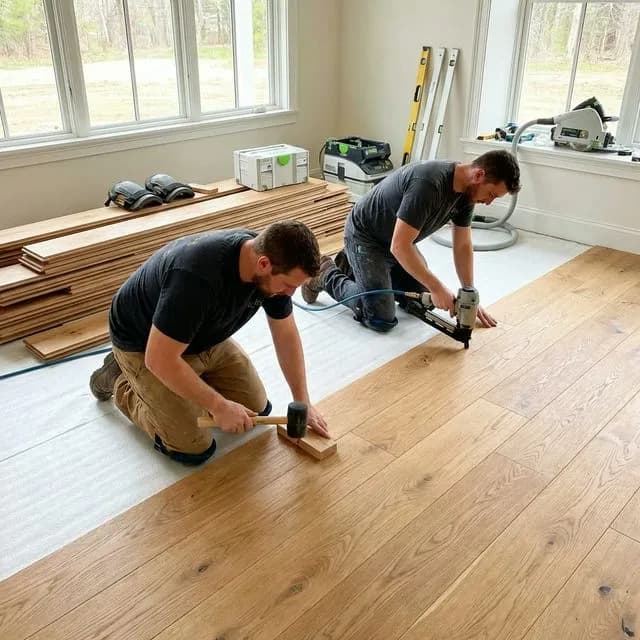
Hardwood installation is a different animal. Solid hardwood needs to be nailed or stapled to a plywood subfloor with a pneumatic flooring nailer. The nailing angle, spacing, and pressure all matter. Too tight and the boards crack. Too loose and they squeak. Engineered hardwood can be glued down or floated, but the glue-down method requires experience with adhesive spread rates and working time. We installed engineered white oak in a Bethlehem colonial last month — the homeowner had originally tried doing it himself, got three rows in, and called us because the planks kept shifting before the adhesive set. Happens more than you'd think.
Ceramic and Porcelain Tile
Tile is where DIY ambitions go to die. It looks straightforward on YouTube, but the reality involves substrate preparation, thinset mixing, back-buttering, leveling clips, grout selection, and expansion joints. A single mistake in mortar coverage means hollow spots that crack under weight six months later. We tore out a DIY tile job in an Allentown kitchen last fall — the homeowner had used the wrong thinset for porcelain, and about 40% of the tiles were debonding from the subfloor. The material was ruined and had to be replaced entirely.
Carpet
Carpet installation requires a knee kicker, a power stretcher, and a seam iron — tools most homeowners don't own and can't easily rent. Carpet that isn't stretched properly wrinkles within a year. Seams that aren't sealed right show immediately. And cutting carpet wrong on a $3,000 material order is an expensive lesson.
Hardwood Refinishing
Refinishing hardwood floors involves drum sanders that can gouge the wood in seconds if you don't know what you're doing. We've been called to fix sanding swirl marks and uneven finish on DIY refinishing jobs in homes across Easton and Nazareth. The drum sander rental is only $75 a day, but the damage it can do in unskilled hands is worth thousands.
The Hidden Costs of DIY Flooring
This is the section most DIY guides skip, and it's the one that matters most. The sticker price of materials is only part of the story. Here's what actually happens on the ground:
Subfloor Surprises
You pull up the old flooring and find rot, mold, uneven patches, or an old layer of asbestos tile. A professional knows what to do with each of those scenarios. A DIYer is suddenly Googling at 9 PM on a Saturday with a torn-up floor and no plan. In older homes across the Lehigh Valley — especially pre-1970s builds in Allentown, Bethlehem, and surrounding Lehigh County — subfloor issues are the rule, not the exception.
Transition Problems
Getting flooring to meet cleanly at doorways, stairs, and where different flooring types meet is genuinely difficult. Improper transitions are the single most visible tell that a floor was DIY installed. They trip people, they look bad, and they're hard to fix after the fact. Professional installers carry dozens of transition profiles and know which one to use in each situation.
Warranty Issues
Many flooring manufacturers void the product warranty if the floor wasn't installed by a certified professional. That premium LVP you bought with a 30-year warranty? It might be reduced to a materials-only warranty — or no warranty at all — if you install it yourself. We've seen homeowners find this out the hard way when a defective batch of planks started delaminating and the manufacturer denied the claim because there was no proof of professional installation.
The Redo Cost
The most expensive flooring installation is the one you have to do twice. When we get called to fix a DIY job, we charge for tear-out of the existing work, disposal, subfloor correction, and reinstallation. That typically runs 30% to 50% more than if we had done the job from scratch. Not because we're penalizing anyone — it's because undoing incorrect work is genuinely harder than starting fresh.
When DIY Makes Sense
Despite everything we've said, there are situations where DIY flooring is a perfectly reasonable choice. We'd rather be honest about that than try to scare everyone into hiring us.
- You're installing click-lock LVP or laminate in a single, simple room — a bedroom with four straight walls, no complex cuts around islands or fireplaces, and a flat subfloor. This is a one-day project for a handy homeowner.
- The subfloor is already in good shape — level, clean, and structurally sound. If you can lay a 10-foot straightedge down and see no gaps larger than 3/16 inch, you're in decent shape for a floating floor.
- You genuinely enjoy this kind of work — some people find the process satisfying. If a weekend spent cutting and clicking planks sounds like fun rather than a chore, go for it.
- Budget is extremely tight — if the choice is between DIY flooring and keeping the old worn-out carpet, DIY wins. An imperfect new floor is still better than a stained 15-year-old carpet.
- It's a temporary situation — you're updating a rental before listing, staging a home for sale, or fixing up a space you don't plan to keep long-term. In those cases, speed and cost matter more than perfection.
Our honest advice: If you fall into one of the categories above and you're using a click-lock product, go for it. Watch a few installation videos from the actual manufacturer (not random YouTube channels), buy 10% extra material, and take your time. You'll probably be fine.
When to Hire a Pro (No Question)
And then there are the situations where professional installation isn't just recommended — it's the only option that makes financial and practical sense. If any of these apply to your project, save yourself the headache:
- You're installing hardwood, tile, or carpet. The skill gap between DIY and professional is enormous for these materials. A bad hardwood installation squeaks. A bad tile installation cracks. A bad carpet installation wrinkles. None of these are easy or cheap to fix.
- Your subfloor needs work. Leveling compound, plywood overlay, moisture barriers on concrete slabs — this is prep work that determines whether your floor lasts 5 years or 25 years. Getting it wrong is invisible at first and devastating later.
- The space is large or open-concept. Installing 200 square feet of LVP in a bedroom is manageable. Installing 1,500 square feet across an open living area with a kitchen island, three doorway transitions, and a fireplace hearth is a completely different project. The layout planning, staggering, and cut work require experience.
- There are stairs involved. Stair flooring is its own specialty. The angles, nose pieces, and adhesive work on stairs are tricky even for experienced installers. DIY stair installations almost always look wrong and can be a safety hazard if treads aren't secured properly.
- You're doing a hardwood refinish. We cannot stress this enough. Drum sanders in inexperienced hands create permanent damage. The finish application requires consistent technique, proper temperature and humidity, and timing between coats that only comes with practice.
- The old flooring contains asbestos. Homes built before 1980 in Pennsylvania and New Jersey frequently have asbestos-containing floor tiles or mastic. Disturbing these materials without proper containment and disposal is both dangerous and illegal. This is a non-negotiable professional job.
- You value your warranty. Professional installation protects both the manufacturer warranty and gives you an installer warranty on the labor. At VM Power Flooring, we stand behind our work — if something goes wrong with the installation, we come back and fix it.
How to Find a Good Flooring Contractor
If you've decided professional installation is the right call, the next challenge is finding somebody who actually does good work. The flooring industry has a low barrier to entry, which means there's a wide range of quality out there. Here's what we'd tell a friend to look for:
Check Their Actual Work
Anybody can put up stock photos on a website. Ask to see photos of recent projects — specifically projects similar to yours. If you need hardwood installed in a 1920s row home with uneven subfloors, you want a contractor who's done exactly that, not someone whose portfolio is all new construction. Read their online reviews and pay attention to the specific details customers mention, not just the star rating.
Get Multiple Quotes (But Don't Just Pick the Cheapest)
We recommend getting three quotes for any flooring project. But here's the thing — the lowest quote is almost never the best value. Ask each contractor exactly what's included. Does the price cover furniture moving? Demolition of existing flooring? Subfloor prep? Transitions and trim? The $4-per-square-foot quote that doesn't include demo and transitions ends up costing the same as the $6-per-square-foot quote that includes everything.
Verify Insurance and Licensing
In Pennsylvania, general contractors need a Home Improvement Contractor registration (HIC). In New Jersey, it's the Home Improvement Contractor registration through the Division of Consumer Affairs. Ask for proof of both liability insurance and workers' comp. If a contractor can't produce these immediately, walk away. No exceptions.
Ask About Their Crew
Some contractors run every job through a rotating cast of different crews week to week. Others, like VM Power Flooring, maintain a consistent core crew of 35+ trained team members for the bulk of our work — with named, vetted trade partners for specialty scopes. Consistency matters: the crew that shows up at your door should be people the company is directly responsible for, with ongoing training and accountability.
Frequently Asked Questions
Is it cheaper to install flooring yourself or hire a professional?
It depends on the flooring type, but DIY is not always cheaper once you factor in hidden costs. For click-lock LVP in a simple rectangular room, you might save $2 to $3 per square foot on labor. But for hardwood, tile, or any room with complex cuts, most DIY homeowners end up spending more due to wasted material, rented tools, and mistakes that require professional correction. We've fixed enough DIY flooring projects across the Lehigh Valley to know that the savings often evaporate once you account for your time and the cost of doing it twice.
What flooring is the easiest to install yourself?
Click-lock luxury vinyl plank is the most forgiving DIY flooring by far. It does not require glue, nails, or special tools beyond a utility knife and a rubber mallet. Click-lock laminate is similar but less tolerant of uneven subfloors. We would not recommend DIY for hardwood, tile, or carpet — each requires specialized skills and tools that make a real difference in the finished result.
How long does it take a professional to install flooring compared to DIY?
A professional crew typically installs 400 to 600 square feet of LVP per day, or 200 to 350 square feet of hardwood or tile. A first-time DIYer should expect to work about three to four times slower. That means a 500-square-foot LVP project takes our crew one day but might take a homeowner an entire weekend or longer, including subfloor prep.
What happens if I mess up a DIY flooring installation?
Minor issues like small gaps at walls get hidden by baseboards. But bigger problems — uneven subfloor causing planks to rock, improper expansion gaps causing buckling, or tiles cracking from bad mortar coverage — usually require pulling up the floor and starting over. We get called to fix DIY flooring projects at least twice a month here in the Lehigh Valley and northern NJ.
Should I DIY flooring in a rental property to save money?
Only if you're experienced and using a forgiving product like click-lock LVP. Rental properties need floors installed correctly because tenants won't baby them. Our clients who manage rental properties consistently tell us that professional installation pays for itself in durability and fewer maintenance calls.
Do I need a permit to install flooring in Pennsylvania or New Jersey?
Standard flooring replacement does not require a permit in PA or NJ. However, if the project involves structural subfloor repair, adding radiant heat beneath the floor, or converting a space where building codes come into play, you may need one. When we encounter structural issues during installation, we flag it immediately and handle the permitting if needed.
Not Sure Which Route Is Right for Your Project?
Look, we're a flooring company — of course we think professional installation is usually the better choice. But we also believe in being straight with people. If your project is a simple LVP install in a spare bedroom and you're handy with tools, you probably don't need us. We'd rather tell you that honestly than take your money for something you could handle yourself.
But if your project involves hardwood, tile, multiple rooms, tricky subfloors, or anything beyond a basic floating floor — that's where VM Power Flooring earns our reputation. With 4,000+ projects completed across Pennsylvania and New Jersey, we've seen every scenario and know how to handle it right the first time.
Reach out for a free estimate — we typically respond the same day. We'll take a look at your space, give you an honest assessment of whether DIY is realistic for your situation, and if professional installation makes more sense, we'll give you a clear, all-inclusive price with no surprises.
About the Author
Founder & Master Installer
Certified: NWFA, CFI
Vincent started refinishing hardwood floors in his early twenties, working alongside his father on weekends between construction jobs in the Lehigh Valley. By 2012, he had enough repeat customers to g...
You Might Also Like
How Much Does Flooring Installation Cost in 2026? Complete Price Guide
Tired of vague price ranges from sites that have never swung a hammer? Here are real, local flooring costs pulled from p...
Read: How Much Does Flooring Installation Cost… Buying GuideHow to Choose a Flooring Contractor: 10 Things to Check Before You Hire
We're a flooring contractor telling you how to vet flooring contractors — including us. Here are the 10 things that actu...
Read: How to Choose a Flooring Contractor: 10 … InstallationHow to Prepare Your Home for Flooring Installation
Every week we show up to a home where the living room is still full of furniture and the dog is loose. Here's everything...
Read: How to Prepare Your Home for Flooring In…