Jen Kowalski
Design Consultant
Open Concept Flooring Ideas: How to Choose One Floor for Your Whole Main Level
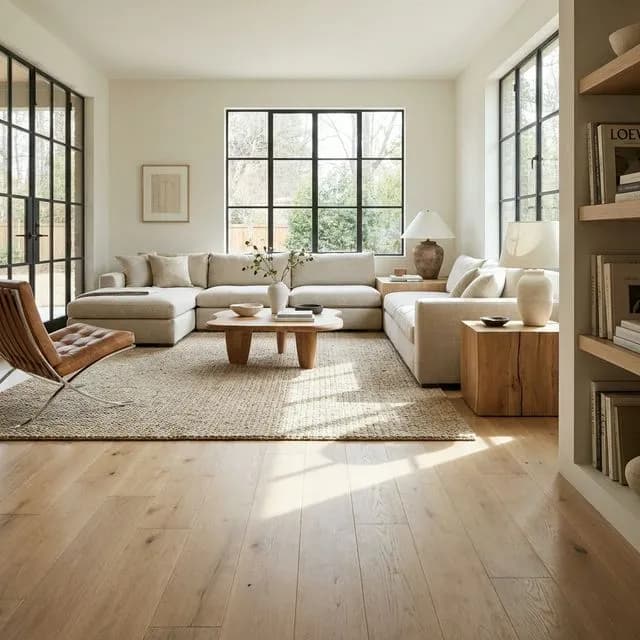
For an open concept main level, choose one continuous floor and run it through the kitchen, dining and living areas. Wide-plank luxury vinyl plank is our usual recommendation because it handles kitchen spills and living room traffic equally well and installs across large areas without transitions. Engineered hardwood is the premium alternative if you want real wood and will care for it.
See our luxury vinyl plank (LVP) installation service
Open concept living sounds great until you have to pick the floor. When there are no walls separating your kitchen, dining room, and living room, the flooring decision that used to be three separate choices becomes one high-stakes call. Get it right and the whole main level feels like one cohesive, well-designed space. Get it wrong and you're staring at a color or texture mismatch every time you walk from the couch to the fridge.
We've installed flooring in hundreds of open concept homes across the Lehigh Valley and northern New Jersey since 2003. Colonials inBethlehem where a wall came down between the kitchen and dining room. New construction in Easton with 40-foot sightlines from the front door to the back slider. Cape Cods in Nazareth where the main level is one continuous space after a renovation. We know what works, what fails, and what looks incredible five years after install day.
This guide is everything our design consultant Jen Kowalski walks homeowners through during open concept consultations — product selection, color strategy, layout direction, transition planning, and the practical details that separate a good floor from a great one. Jen has seven years of interior design experience and a CFI certification, so she brings both the design eye and the technical knowledge. Let's get into it.
The Open Concept Challenge: One Floor to Rule Them All
In a traditional floor plan, you can get away with different flooring in every room. Hardwood in the living room, tile in the kitchen, carpet in the dining room — each space is separated by walls and doorways, so the transitions feel natural. Nobody questions it.
Open concept changes the rules completely. When you can see 600 to 1,200 square feet of continuous floor from a single vantage point, every inconsistency is amplified. A slight color mismatch between two products that looked fine in separate rooms becomes glaringly obvious when they meet in the middle of a wide-open space. A transition strip that was perfectly acceptable in a doorway looks like a speed bump in the middle of your great room.
That's why our default recommendation for open concept homes is simple: one product, one color, wall to wall across the entire main level. No transitions, no color changes, no material switches unless there's a compelling functional reason (like tile at a fireplace hearth or a dedicated mudroom entry).
Jen puts it this way: "In an open plan, the floor is the single largest uninterrupted surface in your home. It's the canvas everything else sits on. If the canvas is busy or inconsistent, nothing else you do with furniture, paint, or lighting will pull the room together."
The challenge is finding one product that works everywhere. Your kitchen needs water resistance. Your living room needs to look warm and inviting. Your entryway needs to handle rock salt and wet boots from November through March. Your dining area needs to survive dropped forks, chair legs, and the occasional red wine spill. One floor has to do all of that while looking like it belongs in every zone.
That's a tall order. But the right product exists, and we install it constantly. Let's talk about what it is.
Our Top Pick: Wide-Plank LVP for Open Floor Plans
If we could only recommend one product for open concept main levels in 2026, it would be wide-plank luxury vinyl plank. Not mid-grade LVP from a big box store. We mean premium, rigid-core SPC planks in a 7- to 9-inch width with a 28-mil wear layer and attached underlayment.
Here's why it wins in open plans specifically:
- Water resistance everywhere. Kitchen spills, entryway slush, dog water bowls, kid accidents — LVP handles all of it without flinching. In an open plan where your kitchen flows directly into your living room, you don't want to worry about a dishwasher leak reaching your couch area. LVP gives you that peace of mind across the entire space.
- Visual consistency over large areas. Premium LVP with embossed-in-register (EIR) texture looks remarkably realistic, especially in the wide-plank formats. The key is choosing a product with at least 8 to 10 unique plank designs in the pattern rotation. Over 800+ square feet of open floor, you want enough variation that the eye doesn't catch repeats. Brands like COREtec, Mohawk RevWood, and Shaw Floorte have gotten very good at this.
- Dimensional stability. SPC (stone plastic composite) cores don't expand or contract with temperature and humidity changes. This matters enormously in open plans because the longer the continuous run, the more expansion and contraction becomes a problem. We've seen hardwood floors buckle in the middle of a 30-foot open kitchen-living room span during a humid July in Allentown. LVP stays put.
- Fast installation with fewer disruptions. An 800-square-foot open main level in LVP takes our crew 1 to 2 days. The same space in hardwood could take 3 to 5 days plus acclimation time. When you're doing the whole main level at once, speed matters — especially if you're living in the house during the project.
We completed an open concept LVP install in a newer colonial in Lower Macungie last fall that really illustrates the point. The main level was about 1,100 square feet — kitchen, dining area, great room, half bath, and entryway, all wide open to each other. The homeowners chose a 9-inch wide SPC plank in a warm natural oak tone with a matte finish. One product, one color, running continuously from the front door to the back patio slider. No transition strips anywhere on the main level. The result was stunning — the space felt enormous, the floor tied everything together, and the homeowners spent $8,900 installed. They had been quoted $16,000 for engineered hardwood to do the same thing.
The one caveat: not all LVP is created equal. For open concept projects, we won't install anything under 6mm thickness with less than a 20-mil wear layer. Cheap LVP feels hollow underfoot, telegraphs subfloor imperfections across large spans, and the click-lock joints can separate over time in high-traffic areas. In an open plan, a separated joint at the kitchen-to-living-room boundary is visible from every seat in the house. We stock and recommend products in the $3.50 to $5.50 per square foot material range because that's where you get the quality that holds up in big, continuous installations.
Hardwood in Open Concepts: Classic but Demanding
Let's be clear — hardwood floors in an open concept home look incredible. There is a warmth and richness to real wood that vinyl cannot fully replicate, and in a large open space where the floor is the dominant visual element, that difference is noticeable. We've installed wide-plank white oak across open main levels in historic Bethlehem homes and newer builds in Forks Township alike, and the "wow" reaction from homeowners is consistent every time.
But hardwood in open plans comes with specific challenges that you need to understand before committing.
Expansion and Contraction
Wood moves. It expands when humidity rises in summer and contracts when your heating system dries out the air in winter. In a traditional room with four walls, this movement is manageable — you leave a small expansion gap around the perimeter and the baseboards cover it. In an open concept with a 25- or 30-foot unbroken run, that movement multiplies.
We did a solid white oak installation in a Bethlehem home two years ago — about 900 square feet of open living space. Beautiful job. By the following August, we got a call. The floor had developed a crown (a slight upward bow) in the center of the long span from the kitchen to the far wall of the living room. Humidity had pushed the planks against each other with nowhere to go. We had left proper expansion gaps, but the run was long enough that the cumulative movement exceeded them. We had to come back, pull up a few rows, and re-cut the gaps wider.
This is why we recommend engineered hardwood over solid for open concept layouts. Engineered planks have a plywood or HDF core with a real wood veneer on top. The cross-layered construction resists expansion and contraction much better than solid wood. You get the look and feel of real hardwood with significantly better dimensional stability over long, continuous runs.
Water Vulnerability in the Kitchen Zone
In an open concept home, your kitchen floor is your living room floor. That means the same wood that looks gorgeous under your dining table is also sitting next to your dishwasher, under your sink, and three feet from your refrigerator's water line. We've pulled up water-damaged hardwood from more open concept kitchens than we can count. The dishwasher leak is the silent killer — it drips for weeks before anyone notices, and by then the damage has spread well beyond the kitchen zone into the adjacent living area.
If you're set on hardwood in an open plan, engineered hardwood with a sealed edge treatment gives you better protection against kitchen moisture. Some manufacturers are now offering waterproof-core engineered hardwood that handles standing water for up to 72 hours. It's not cheap — expect $9 to $14 per square foot for the material alone — but it addresses the single biggest risk of hardwood in an open kitchen-living layout. Check our hardwood versus LVP comparison for a detailed breakdown of performance differences.
Cost Across a Full Main Level
Hardwood gets expensive fast when you're covering an entire open main level. Material and labor for 1,000 square feet of engineered white oak in a matte finish runs $9,000 to $14,000 in our market. For wide-plank (7-inch or wider), add another 15 to 20 percent. That same coverage in premium LVP would be $6,000 to $10,000. On whole-level projects, the difference is significant enough that most families in the Lehigh Valley choose LVP and put the savings toward kitchen or bathroom upgrades.
How to Handle the Kitchen-to-Living Room Transition
This is the question that comes up in nearly every open concept consultation. The kitchen has different functional demands than the living room — more water exposure, more dropped objects, more grease splatter, more standing in one spot for long periods. So even if you're using one continuous product, the kitchen zone deserves specific attention.
Option 1: Same Floor Everywhere (Our Preference)
If you're going with LVP, this is the easy call. Run the same product continuously from kitchen to living room without any transition. LVP handles the kitchen demands — water, grease, impact — just as well as it handles the living room demands. No transition strip, no height change, no visual break. This is what we do in the majority of our open concept installs and it's what Jen recommends for almost every client.
With hardwood, same-floor-everywhere still works, but you need to be more deliberate about the kitchen zone. Place runner-style mats in front of the sink and dishwasher (we recommend washable, flat mats rather than cushy rugs that trap moisture underneath). Install water leak sensors behind the dishwasher and under the fridge. And wipe up spills immediately — hardwood gives you a few minutes before water starts penetrating the finish, but it's not forgiving.
Option 2: Tile in the Kitchen, LVP or Hardwood in Living Areas
Some homeowners want tile in the kitchen zone for maximum durability and water protection, especially if they cook heavily or have a commercial-grade range. This works well in open plans if you plan the transition carefully.
The key is defining where the kitchen ends. In most open concepts, there's a natural boundary — an island, a change in ceiling height, a beam, or the edge of the cabinetry line. That's where you place the transition. We use a flush schluter strip or a slim T-molding set at exactly the same height as both surfaces so there's no trip hazard and no visual bump.
We did a project in a Morristown ranch-style home where the homeowner wanted large-format porcelain tile (24x24) in the kitchen and wide-plank LVP in the living and dining areas. The island provided a natural dividing line. We ran the tile right up to the island base on the kitchen side and started the LVP on the other side with a slim color-matched aluminum transition. From the living room, you could see the material change, but it looked intentional because it followed the architecture of the island. That's the difference between a planned transition and a random one.
Option 3: Area Rugs to Define Zones
Here's a design trick Jen uses constantly that costs almost nothing: use area rugs to visually define zones within an open plan while keeping the floor continuous underneath.
"A large area rug under your dining table and another under your living room seating group does two things," Jen explains. "It gives each zone its own visual identity, and it makes people subconsciously read the space as having distinct areas even though the floor is one continuous surface. It's the easiest way to create definition without adding transition strips or mixing materials."
This approach is especially effective in Lehigh Valley colonials that have been opened up by removing a dining room wall. The room is now one big space but it still functions as two zones — a rug helps define that. Visit our luxury vinyl or hardwood service pages for details on what we offer for open concept projects.
Color and Tone: What Works in Lehigh Valley and NJ Homes
Color selection becomes even more critical in an open concept home because you're committing to a single tone across a massive visual area. In a traditional floor plan, a slightly-too-dark stain in the hallway is easy to ignore. In an open layout where that same color runs across 1,000 square feet, it defines the entire personality of your main level.
Based on what we're seeing in our projects right now — both new installs and refinishing jobs — here are the tones that work best in open floor plans.
Light Natural Oak (The Current Sweet Spot)
Light natural oak is our number one recommendation for open concepts, and it's not close. A natural white oak tone with a matte finish — either in hardwood or LVP — does everything right in a big open space. It reflects light, making the room feel brighter and larger. It hides dust and small debris better than dark floors (critical when 800+ square feet of floor is visible at once). And it works with virtually any wall color, cabinet finish, or furniture style.
We installed natural white oak engineered hardwood across a 1,200-square-foot open main level in a newer home in Palmer Township last spring. The homeowners had white shaker cabinets in the kitchen, sage green walls in the living area, and warm gray in the dining zone. The light oak floor tied all three color schemes together seamlessly. That's the power of a neutral, natural tone in an open plan.
Warm Honey Tones
One step warmer than natural oak, honey-toned floors add a subtle golden warmth that's particularly beautiful in homes with good natural light. We see this choice a lot in Lehigh Valley homes with south-facing living rooms where the sunlight picks up the honey undertones and makes the whole space glow in the afternoon.
Honey works especially well with warm white walls, brass or gold hardware, and mid-century or transitional furniture. It's less versatile than pure natural oak — it can clash with cool gray walls or stark white cabinetry — so Jen always checks the full palette before recommending it.
What to Avoid in Open Plans
Very dark floors (espresso, ebony, dark walnut): They look dramatic in photos but show every speck of dust, every crumb, every pet hair. In a closed room, you clean 150 square feet and you're done. In an open plan, you're constantly aware of debris across the entire main level. We installed a dark espresso hardwood in a Bethlehem open concept about three years ago at the homeowner's insistence. They called us four months later asking about refinishing to a lighter color. They couldn't keep up with how much it showed dirt.
Gray tones: Gray had its moment from about 2016 to 2022, and it's now reading as dated to most buyers and designers. In an open plan where the floor dominates the visual field, a trend-specific color ages the entire space. Natural and warm tones have stayed relevant for decades and will continue to. If you're curious about what's current, our 2026 flooring trends guide covers the full picture.
High-contrast grain patterns: Floors with heavy grain variation (like rustic hickory or character-grade oak) can overwhelm an open space. The visual noise competes with everything else in the room. In a 12x12 bedroom, character-grade oak looks charming. Across 1,000 continuous square feet, it can feel frantic. We recommend a select or #1 common grade for open plans — enough grain variation to look natural but not so much that it dominates the room.
Pattern Layouts: Running Bond, Herringbone, or Diagonal?
The pattern you lay your planks in changes the entire feel of an open space. This is an area where Jen's design background really comes into play, because layout is one of those things that most homeowners don't think about until the installers are already on-site — and by then, it's too late to change course without wasting time and material.
Running Bond (Standard Stagger)
This is the layout we install in about 70 percent of open concept jobs. Planks run in one direction with staggered end joints — each row offset by at least 6 inches from the previous one (we do 8 to 12 inches minimum). It's clean, it's timeless, and it draws the eye in a single direction, which makes open spaces feel longer and more spacious.
The critical decision with running bond is which direction to run the planks. Our standard practice: run parallel to the longest wall with the most natural light. In most Lehigh Valley colonials, that means front to back. In many NJ ranches, it's left to right following a long window wall. The planks should "point" toward the main focal point of the space — usually the fireplace, the back windows, or the kitchen island.
We installed running-bond LVP in a Cape Cod in Northampton Borough where the homeowner had removed the wall between the kitchen and living room. The main level was about 750 square feet. We ran the planks from the front door straight back toward the sliding glass door to the deck. The result was a visual runway that made the modestly-sized space feel significantly larger than it is. That directional pull is the whole point of running bond in an open plan.
Herringbone
Herringbone is having a moment, and it looks extraordinary in open concepts — when it's done right. The V-shaped zigzag pattern creates a sense of movement and sophistication that a straight layout can't match. We've installed herringbone in several North Jersey homes where the homeowners wanted a design-forward statement, and every one of them has been a showstopper.
But herringbone in an open plan comes with real considerations:
- Cost: Plan on 25 to 40 percent more for labor versus running bond, plus 10 to 15 percent more material for cuts and waste. On a 1,000-square-foot open main level, that adds $2,000 to $4,000 to the project.
- Scale: Herringbone works best with planks in the 4- to 6-inch width range. The wider planks that look great in running bond (7 to 9 inches) can look clunky in herringbone because the individual V-shapes become too large. This means you may need a different product than what you'd choose for a standard layout.
- Visual weight: Herringbone is visually active. In an open plan, it becomes the dominant design element in the room. That's great if you want the floor to be the star. It's not great if you have a lot of other strong design elements competing for attention — bold wallpaper, a dramatic kitchen backsplash, heavily patterned upholstery.
Jen's advice: "If you're considering herringbone in an open plan, keep everything else simple. Light walls, clean cabinet lines, minimal pattern elsewhere. Let the floor carry the design weight. One show-stopper per room — that's the rule."
Diagonal Layout
Running planks at a 45-degree angle to the walls is a middle-ground option between the simplicity of running bond and the drama of herringbone. It adds visual interest without the complexity or cost premium of a pattern layout. In open plans where the room shape is slightly irregular — common in older Lehigh Valley homes where walls are rarely perfectly square — a diagonal layout can actually hide imperfections because the angle draws attention away from out-of-square walls.
The trade-off is material waste. Diagonal layouts produce more cut-offs at the walls, typically adding 10 to 15 percent to your material needs. Labor is only slightly more than running bond because the cuts are straightforward — just angled rather than straight.
We installed a diagonal LVP layout in a renovated split-level in Phillipsburg where the main level had an unusual L-shape after a wall removal. Running bond in any single direction would have emphasized the awkward geometry. The diagonal pulled the eye across the room at an angle that minimized the odd proportions. It was Jen's call, and the homeowners were amazed at how much more balanced the room felt.
The Transition Strip Question (And How to Avoid Them)
Transition strips are the bane of open concept flooring. They're functional — they cover the gap between two different flooring surfaces or between rooms — but in an open plan, they break the visual flow that you're paying good money to create. Every transition strip is a visual interruption that tells your eye "two separate spaces" instead of "one cohesive room."
Our goal on every open concept project is zero transition strips on the main level. Here's how we achieve that.
Use One Product Everywhere
This is the obvious one, but it's worth stating. If the same LVP or hardwood runs through the kitchen, living room, dining room, and hallway without any material changes, there are no transitions needed. The floor is continuous. The only transitions happen at doorways to rooms that should have different flooring — bathrooms with tile, bedrooms with carpet, etc.
Proper Expansion Gap Planning
Even when using one product wall to wall, you still need expansion gaps — especially for floating LVP and engineered hardwood installations. In most rooms, the gap is hidden by baseboards at the perimeter. But in long, open runs, some products require an expansion break every 30 to 40 feet (depends on the manufacturer's specs).
Here's where a lot of DIY installations and less experienced contractors create problems: they hit the manufacturer's maximum continuous run limit and have to put a T-molding in the middle of the floor. That T-molding sits right in the middle of your open room and looks awful.
Our approach: we plan the layout so that any required expansion breaks fall at logical architectural lines — under a doorway, along a cabinet toe kick, at a change in ceiling height, or behind an island where it's hidden. This takes careful measurement during the estimate phase, and it's one of the reasons professional installation makes a real difference in open plans.
Flush Transitions Where Materials Must Change
Sometimes you need two different materials — tile in the entry, LVP everywhere else, for example. When that happens, we eliminate the height difference between the two surfaces so the transition can be as slim as possible. This usually means building up or routing down the subfloor on one side to bring both surfaces flush. Then we use a slim aluminum or color-matched transition profile rather than a bulky snap-in T-molding.
The difference between a standard transition strip and a flush transition is night and day. Standard strips rise 1/4 to 3/8 inch above the floor surface. Flush transitions sit at or just barely above floor level. You feel them slightly underfoot but they don't visually interrupt the space. We did a tile-to-LVP flush transition in a Bergen County open concept last year, and the homeowner didn't notice it was there until we pointed it out during the walkthrough. That's the goal.
Dealing with Doorways Between Open and Closed Rooms
At some point your open main level meets a room with a different floor — a tiled bathroom, a carpeted bedroom, a laundry room. These transitions happen in doorways, which is where your eyeexpects to see a change. A clean transition strip in a doorway looks natural. The same strip in the middle of an open room looks like a mistake.
We position doorway transitions directly under the door when closed, so when the door is shut, the transition is hidden. When the door is open, the strip is right at the threshold where it makes visual sense. It's a small detail, but these small details are what separate a professional installation from a good-enough-for-now job. For more on what professional installation includes, check out our guide on how to prepare your home for flooring installation.
Ready to Floor Your Open Concept?
Choosing the right floor for an open concept main level is one of the biggest design decisions you'll make in your home. It affects how the space looks, how it feels underfoot, how easy it is to maintain, and how well it holds up over time. There is no one-size-fits-all answer, which is exactly why we walk every client through the same process Jen outlined in this guide.
We've been installing open concept floors across the Lehigh Valley and northern New Jersey since 2003, with over4,000+ completed projects and a team of 35+ professionals who do this every day. We know the housing stock, we know the products, and we know what holds up in real PA and NJ homes with real families, real pets, and real weather.
If you're planning an open concept project — whether it's a whole-level LVP install, a hardwood refresh after a wall removal, or a full renovation that needs flooring from scratch — we'd love to help. Check out our LVP installation services and hardwood installation services, read our Allentown flooring page, run some numbers on our cost calculator, or reach out for a free estimate. We typically respond the same day. Or call (201) 294-1625.
Explore Our Related Services
About the Author
Design Consultant
Certified: CFI
Jen handles in-home consultations and helps homeowners pick the right floor for their space, budget, and lifestyle. She came from the interior design side — seven years at a kitchen-and-bath firm in B...
You Might Also Like
Top Flooring Trends for 2026: What Homeowners Are Choosing
Pinterest boards are one thing. What homeowners actually pick when they're spending real money is another. Here's what w...
Read: Top Flooring Trends for 2026: What Homeo… ComparisonHardwood vs. Luxury Vinyl Plank: Which Is Better for Your Home?
After installing thousands of floors across the Lehigh Valley and northern New Jersey, here's what we actually tell home...
Read: Hardwood vs. Luxury Vinyl Plank: Which I… Cost GuideHow Much Does Flooring Installation Cost in 2026? Complete Price Guide
Tired of vague price ranges from sites that have never swung a hammer? Here are real, local flooring costs pulled from p...
Read: How Much Does Flooring Installation Cost…