Danny Reyes
Lead Installer — Hardwood Specialist
Hardwood Floor Refinishing Cost Guide 2026: Real PA & NJ Pricing
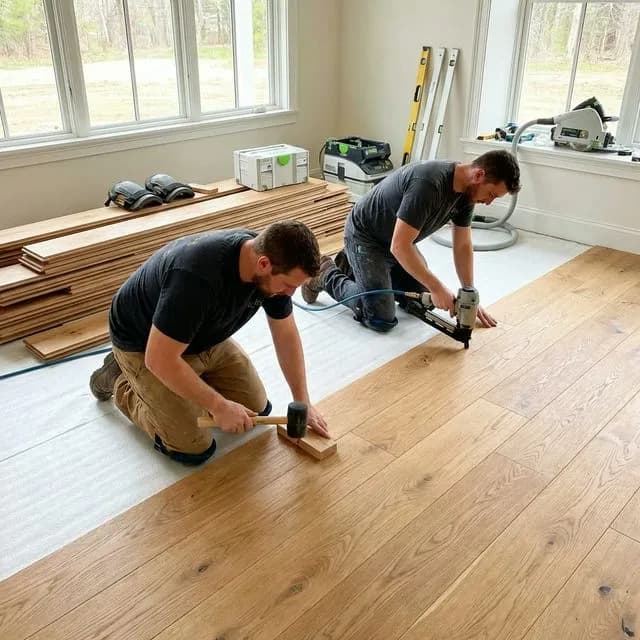
I'm Danny Reyes, lead installer at VM Power Flooring. I've been sanding and refinishing hardwood floors across eastern Pennsylvania and northern New Jersey since 2003. Our team of 35+ professionals has completed over 4,000+ flooring projects, and refinishing is one of the things we do most often — especially in older neighborhoods throughout the Lehigh Valley where original hardwood is hiding under decades of carpet.
Here's the problem with Googling "hardwood refinishing cost" — you get a bunch of national averages that don't mean anything if you live in Bethlehem, Allentown, or Hackensack. The prices I'm laying out in this guide are what we actually charge in 2026, based on real jobs we've completed this year and last. Not estimates from a database. Not numbers pulled from a contractor in Texas.
If you want a fast answer, you can use our free cost calculator or request a quote directly. But if you want to understand why refinishing costs what it does — and how to avoid overpaying — this is the guide to read.
Why Refinishing Prices Vary So Much (The Real Reasons)
Let me explain something that frustrates homeowners all the time. You call three refinishing companies, and you get three wildly different numbers. One says $2,800. Another says $5,500. A third says $4,200. Same house, same floors. What's going on?
The answer is that refinishing isn't one thing. It's a spectrum of services, and different companies include different things in their quotes. The $2,800 guy might be planning to do a quick screen and recoat — not a full sand-down. The $5,500 company might be including board replacements, stain, three coats of premium poly, and full dust containment. The $4,200 quote might land somewhere in the middle.
Here are the real factors that drive price differences:
- Floor condition — A floor that's been under carpet for 30 years and just needs cosmetic work is totally different from a floor with deep gouges, pet stains soaked into the wood, water damage near exterior doors, or boards that have cupped from moisture problems. Worse condition means more sanding passes, more filler, and potentially board replacements — all of which add labor hours.
- Square footage — Larger projects have a lower per-square-foot cost because setup and equipment transport are fixed costs. Refinishing 300 square feet in a single bedroom costs more per foot than refinishing 1,500 square feet of open first floor. Our minimum charge for any refinishing job is around $1,500 regardless of size, because the setup and cleanup take the same amount of time whether we're doing one room or five.
- Finish system — There's a real cost difference between a basic oil-based polyurethane and a premium water-based system like Bona Traffic HD or Loba 2K Supra AT. The premium finishes cost more per gallon but they cure harder, last longer, and look better. I'll break this down in detail below.
- Stain vs. natural — Going with a natural clear coat is the simplest and cheapest option. Adding stain means an extra application step, more drying time, and more skill to apply evenly — especially on species like maple that absorb stain unevenly.
- Access and layout — A wide open living room with no obstacles sands fast. A series of small rooms with tight corners, closets, radiators, and built-in cabinets takes significantly longer. Older homes in the Lehigh Valley — I'm talking those beautiful row houses in South Bethlehem, the colonials in Fountain Hill, the Victorians in West End Allentown — those homes have layouts that slow us down. Lots of doorways, narrow hallways, floor registers, and tight spaces that the big sander can't reach. All of that edging and detail work is done by hand.
- Dust containment — Full dust containment systems (plastic barriers, negative air pressure, HEPA filtration) add $0.50 to $1.00 per square foot to the job. We include basic dust containment on every job, but for homes where clients are living in the house during the work, or where there are health concerns, we set up comprehensive containment. This is standard practice for us — not every company bothers.
Basic Sand and Refinish: $3-$5 Per Square Foot
This is the bread and butter of what we do. A basic sand and refinish means we're taking your existing hardwood floors down to bare wood with a drum sander and edger, filling any gaps or nail holes with wood filler, and then applying three coats of polyurethane — either oil-based or water-based.
For floors in decent condition — meaning the wood is structurally sound, no major board damage, and no deep staining that's penetrated below the surface — this is all you need. And it's where most projects fall.
Here's how the pricing breaks down in our market:
| Project Size | Price Range | Typical Total |
|---|---|---|
| Small (under 500 sq ft) | $4.00 - $5.00/sq ft | $1,500 - $2,500 |
| Medium (500 - 1,000 sq ft) | $3.50 - $4.50/sq ft | $2,500 - $4,500 |
| Large (1,000 - 2,000 sq ft) | $3.00 - $4.00/sq ft | $3,500 - $8,000 |
| Whole house (2,000+ sq ft) | $3.00 - $3.75/sq ft | $6,000 - $10,000+ |
We just finished a 1,400 square foot refinish in a colonial in Emmaus — red oak throughout the entire first floor. The floors had been carpeted since the early '90s but the wood underneath was in excellent shape. Three coats of Bona Traffic HD water-based poly, no stain. Total came to $5,250, which worked out to about $3.75 per square foot. The homeowners were shocked at how good 70-year-old oak looked once we sanded through the old finish.
Now let's talk about finish systems, because this is where a lot of the cost variation comes from.
Oil-Based Polyurethane: The Classic Choice
Oil-based poly has been the industry standard for decades. It's what your parents' floors were probably finished with. The material is cheaper — a gallon of quality oil-based poly runs $45 to $65 compared to $80 to $130 for premium water-based. On a per-square-foot basis, oil-based poly adds about $0.75 to $1.25 for materials across three coats.
The pros of oil-based poly:
- Lower material cost
- Warm, amber tone that many people love on red oak
- Self-levels well — very forgiving to apply
- Time-tested durability
The cons:
- Strong fumes — you cannot stay in the house during application. This is non-negotiable. The VOCs are serious.
- Slow dry time — 24 hours between coats minimum. A three-coat job takes 4 to 5 days.
- Yellows over time, which can change light stain colors
- Longer cure time — takes 30 days to fully harden. You can walk on it in 48 hours, but it's not fully cured for a month.
Water-Based Polyurethane: The Modern Standard
Water-based poly has improved dramatically over the past decade. The old knock on it was that it wasn't as durable as oil-based. That's no longer true with commercial-grade products. We use Bona Traffic HD as our primary water-based system, and for good reason — it's one of the hardest finishes on the market, period.
The material cost is higher. Bona Traffic HD runs about $110 to $130 per gallon. Loba 2K Supra AT, another excellent system we use, is in the same range. On a per-square-foot basis, water-based poly adds $1.00 to $1.75 for materials across three coats. So yes, it's roughly $0.50 more per square foot in materials compared to oil-based.
But here's where water-based saves you money:
- Faster dry time — 2 to 3 hours between coats, so we can apply all three coats in a single day in many cases
- Lower fumes — you still shouldn't be in the room during application, but the VOCs are dramatically lower. Some clients stay in the house (in other rooms) during water-based jobs.
- Crystal clear finish — no yellowing, no ambering over time
- Faster cure — fully hardened in about 7 days vs. 30 for oil
The labor savings from faster dry time often offset the higher material cost. On a large job, water-based can actually come in at the same total price as oil-based because we finish a day sooner. That's a day less labor for our crew.
Stain Color Change: Add $1-$2 Per Square Foot
Changing the color of your hardwood floors is one of the most popular requests we get. Maybe you've got orange-toned red oak from the '80s and you want something more modern. Or maybe you're going for a dark walnut or ebony look to match your kitchen renovation. Staining is how we get there.
Adding stain to a refinishing project typically adds $1 to $2 per square foot on top of the base sand-and-refinish price. So instead of $3 to $5 per square foot, you're looking at $4 to $7 per square foot for a full sand, stain, and refinish.
Why does stain add cost?
- Extra application step — Stain is applied after sanding and before poly. It needs to be worked into the wood evenly and then wiped off. On a large floor, this can take an entire day for a crew of two.
- Drying time — Stain needs 24 hours to dry before we can apply the first coat of poly. That adds a full day to the project timeline.
- Skill requirement — Applying stain evenly is harder than it looks. Lap marks, uneven absorption, and blotchiness are common problems with less experienced crews. Certain species like maple and birch are notoriously difficult to stain evenly — they have inconsistent absorption that creates a blotchy appearance unless you use a pre-stain conditioner or a specialty stain system.
- Material cost — A gallon of quality wood stain runs $35 to $55. For 1,000 square feet you'll need 2 to 3 gallons. The stain itself isn't the expensive part — it's the labor.
Popular stain colors we're doing in 2026:
- Jacobean — A rich medium-dark brown. This is probably our most requested stain right now. Works beautifully on white oak and red oak alike.
- Special Walnut — A warm medium brown with some depth. Very versatile — works with both traditional and modern interiors.
- Ebony / True Black — The ultra-dark, almost black floor has been trending for a few years now. It looks stunning but shows every speck of dust. We always warn clients about the maintenance reality before they commit.
- Provincial — A lighter warm brown. Great for clients who want to tone down the orange in red oak without going too dark.
- 50/50 mix (Ebony + Jacobean) — This custom mix gives you a deep espresso tone that's become extremely popular. We're doing this combination in probably one out of every four stain jobs right now.
One thing I always tell clients: we do a stain sample on your actual floor before we commit to the full room. Wood species, age, and grain pattern all affect how stain looks. What you see on a sample chip at the store is not exactly what you'll get on your floor. We sand a small test area — usually in a closet or under where the couch goes — and apply the stain so you can see the real color on your real wood before we do the entire floor.
We recently did a 1,100 square foot stain-and-refinish in a 1955 cape cod in Fountain Hill. The homeowner wanted to take her original red oak floors from the natural honey color to a dark Jacobean stain. We sanded everything down, applied the stain, and put on three coats of Bona Traffic HD. Total came to $5,830 — about $5.30 per square foot. The transformation was dramatic. Those floors looked like they belonged in a completely different house.
Check out examples on our hardwood refinishing services page or read our comparison of refinishing vs. replacing hardwood to see if refinishing is the right call for your floors.
Screen and Recoat: The $1.50-$2.50 Budget Option
If your floors are in decent shape but just looking dull, scratched up on the surface, or the finish is wearing thin in high-traffic areas, a screen and recoat might be all you need. This is the most underutilized service in the refinishing world, and it can save you serious money.
Here's what a screen and recoat involves: we lightly abrade the existing finish with a buffer and a screen (a mesh abrasive pad — not a full sanding). This scuffs up the old finish so the new coat of poly will bond to it. Then we apply one or two fresh coats of polyurethane on top. We're not going down to bare wood. We're not removing the stain. We're just refreshing the top layer.
| Screen and Recoat | Price Range |
|---|---|
| One coat of poly | $1.50 - $2.00/sq ft |
| Two coats of poly | $2.00 - $2.50/sq ft |
The catch: a screen and recoat only works if the existing finish is in relatively good condition. If there are areas where the finish has worn completely through to bare wood, a screen and recoat won't work properly — the new poly won't bond consistently, and you'll get peeling and flaking within a year. We see this happen all the time when DIYers or inexperienced contractors try to screen and recoat a floor that really needed a full sand-down.
A screen and recoat is ideal when:
- Your floors were refinished 3 to 5 years ago and just need a refresh
- There are surface scratches but the finish hasn't worn through
- You're happy with the current color and just want renewed protection
- You're selling your home and want the floors to shine for showings
- You're on a tight budget and a full refinish isn't in the cards right now
We did a screen and recoat on a 900 square foot first floor in Hellertown last month. The floors had been refinished about six years ago and were showing normal wear in the kitchen and hallway areas. Two coats of Bona Traffic HD, done in one day. The homeowner was back on the floors the next evening. Total cost: $1,980. A full sand-and-refinish would have been $3,600 to $4,000. She saved over $1,600 and the floors look fantastic.
Repair Work: Board Replacement, Patching, and Filling
This is where refinishing costs can start climbing. If your floors have damage beyond normal surface wear — cracked boards, water damage, pet stain penetration, termite damage, missing pieces, or sections that have been cut out for plumbing or HVAC work — those issues need to be addressed before we sand and finish.
Here's what repair work typically costs:
| Repair Type | Cost Range |
|---|---|
| Board replacement (individual boards) | $15 - $30 per board |
| Section replacement (larger area) | $8 - $15 per sq ft |
| Pet stain treatment (enzyme + sanding) | $50 - $150 per spot |
| Gap filling (entire floor) | $0.50 - $1.00 per sq ft |
| Water damage repair | $200 - $800+ per area |
Board replacement is the most common repair we do. The process involves carefully cutting out the damaged board with a multi-tool, chiseling out the tongue-and-groove edges, and then fitting a new board in its place. It's tedious, skilled work. Finding matching wood is sometimes the hardest part — especially for older species or unusual widths. We keep a stock of reclaimed red oak, white oak, and maple boards specifically for repair work in older Lehigh Valley homes.
Pet stains are a whole category of their own. Surface pet stains — the ones that are just in the finish layer — sand out easily and don't add much cost. But deep pet stains that have soaked through the finish and into the wood fibers? Those are a different story. Sometimes the stain and odor have penetrated so deeply that the board needs to be replaced entirely. Other times, we can treat the area with an enzyme cleaner, do some extra sanding, and apply a shellac-based sealer to block the remaining odor before finishing. We see a lot of pet damage in homes throughout Allentown and Bethlehem — it's probably the number one repair issue we deal with on refinishing jobs.
Gap filling is another common request, especially in older homes. Hardwood floors expand and contract with seasonal humidity changes, and over decades, gaps develop between boards. We can fill gaps up to about 1/8 inch with a flexible wood filler that's color-matched to the floor. For larger gaps, we sometimes use rope caulk or thin strips of matching wood called "splines." Full-floor gap filling adds $0.50 to $1.00 per square foot.
A word of honesty: if more than 30 to 40 percent of your boards need replacement, it's usually more cost-effective to do a full tear-out and new installation. We'll always tell you that upfront. Our owner Vincent Karaca has built this company on honest assessments — we'd rather give you the straight answer than sell you a refinishing job that's going to disappoint you.
The Hidden Costs Nobody Mentions
Every refinishing company quotes a per-square-foot price. But there are costs that can add up on top of that base number. Some of these are standard and should be included in every quote. Others are legitimate extras that not every job requires. Here's what to watch for:
- Furniture moving: $100 - $400. We include basic furniture moving in our quotes — couches, tables, chairs, beds. But extremely heavy or fragile items like pianos, china cabinets, or large aquariums are extra. Some companies charge for all furniture moving as a separate line item. Ask upfront.
- Staircase surcharges: $25 - $50 per step. Stairs take significantly longer per square foot than flat floors. Every tread, riser, and stringer needs to be sanded by hand or with a detail sander — the big drum sander can't do stairs. A typical 14-step staircase adds $350 to $700 to a refinishing job. Curved or open-sided staircases cost even more because the detailing is intricate. We refinish a lot of staircases in the older three-story homes in West Bethlehem and the Victorians on Center Street in Easton — those ornate newel posts and balusters add complexity.
- Closet floors: $75 - $150 per closet. Most quotes are based on the main room dimensions and don't include closets unless specifically discussed. Closets are tight spaces that require hand sanding and edging, so the per-square-foot cost is higher even though the total area is small.
- Baseboard and trim removal/reinstallation: $1 - $3 per linear foot. For a clean refinishing job, baseboards should ideally come off so we can sand right to the wall. Not every company does this — some just sand up to the baseboard and leave a small gap. If you want baseboards removed and reinstalled, it's usually an extra charge.
- Dust containment upgrades: $0.50 - $1.00 per sq ft. We run dustless sanding systems on every job — our equipment connects to HEPA-filtered vacuum units that capture the vast majority of dust at the source. But "dustless" doesn't mean zero dust. For clients who want full-room plastic barriers, negative air pressure, and zip walls between the work area and the rest of the house, that's an upgrade. It's worth it if you're living in the house during the project or if anyone in the household has respiratory issues.
- Nail-down carpet staple removal: $0.50 - $1.00 per sq ft. If we're refinishing floors that were under carpet, someone has to pull all those tack strips and staples. There are usually hundreds — sometimes thousands — of staples embedded in the wood. Each one needs to be pulled individually. On a 1,000 square foot job, this can add two to three hours of labor. Some companies include this in their price, some don't.
- Transition strips and thresholds: $25 - $60 each. Every doorway where refinished floors meet a different floor surface needs a clean transition. In a typical house, that's 5 to 10 transitions.
DIY vs Professional: An Honest Cost Comparison
I'm going to be straight with you about this. Yes, you can rent a drum sander from Home Depot or your local rental shop. Yes, the material costs are relatively low. And yes, there are YouTube videos that make it look manageable. But I've been doing this for over a decade, and I've seen the aftermath of DIY refinishing jobs more times than I can count.
Let's look at the actual DIY cost breakdown:
| DIY Item | Cost |
|---|---|
| Drum sander rental (3 days) | $180 - $250 |
| Edger rental (3 days) | $100 - $150 |
| Buffer rental (1 day) | $50 - $75 |
| Sandpaper (various grits) | $100 - $200 |
| Polyurethane (3 coats, 1,000 sq ft) | $150 - $350 |
| Stain (if applicable) | $70 - $120 |
| Applicators, brushes, tape, supplies | $75 - $150 |
| Total DIY cost (1,000 sq ft) | $725 - $1,295 |
Compare that to a professional job at $3,000 to $5,000 for 1,000 square feet. On paper, DIY saves you $2,000 to $3,700. That's real money. I won't pretend it's not.
But here's where the math gets complicated. The drum sander is the single most dangerous power tool you can rent. I'm not exaggerating. It removes wood aggressively and unforgivingly. If you pause in one spot for even two seconds, you've created a visible dip in the floor. If you don't keep it moving in a perfectly straight line, you'll leave drum marks — parallel gouges that show through the finish like a neon sign. If you don't progress through the grits properly (36, 60, 80, 100, 120), you'll end up with cross-grain scratches that only become visible after you apply the finish — by which point it's too late.
The edger is almost worse. It's a spinning disc that you hold against the floor along the walls. It swirls. It gouges. It bounces. Getting a feathered edge that blends seamlessly with the drum-sanded center of the room takes practice — a lot of it. Pros develop this skill over hundreds of jobs. First-timers almost always end up with visible "picture frame" edges where the edger marks don't blend with the center.
And then there's the finish application. Applying polyurethane evenly across a large floor without lap marks, bubbles, drips, or missed spots takes technique. Oil-based poly is more forgiving because it self-levels. Water-based poly is trickier — it dries faster, so you have less working time, and it shows every imperfection in the application.
Here's what we've seen in real life. A homeowner inCatasauqua rented a sander and tried to refinish the first floor of his 1920s bungalow. He did the sanding over a long weekend, and it looked okay-ish to his eye before the finish went on. But once he applied the stain, every drum mark, every swirl mark, every spot where the edger dug in became glaringly visible. He called us to fix it. We had to re-sand the entire floor — back to square one — and then do the full stain and finish. His total cost ended up being the rental fees he'd already spent, plus our full refinishing price. He paid nearly double what it would have cost to just hire us from the start.
I see this pattern repeat at least three or four times a year.
How to Get the Best Value on Your Refinishing Project
After 4,000+ projects since 2003, we've seen every way a refinishing project can go right and every way it can go wrong. Here's how to make sure you get the best value — not the cheapest price, but the best result for your money.
1. Get at Least Three Quotes — and Compare Apples to Apples
This sounds obvious, but most homeowners don't actually compare the same scope of work. Make sure every quote includes the same services: number of poly coats, stain (or no stain), dust containment, furniture moving, closets, stairs, and what brand of finish they're using. A quote for two coats of generic poly is not the same as a quote for three coats of Bona Traffic HD — even if the square footage is identical.
2. Ask About the Finish System by Name
This is one of the biggest indicators of quality. A company that uses Bona, Loba, or Pallmann finish systems is using professional-grade products. A company that just says "polyurethane" without specifying the brand might be using contractor-grade products from the hardware store. There's nothing wrong with those products for a basic job, but the longevity and appearance aren't the same.
Our go-to systems at VM Power Flooring are Bona Traffic HD (water-based) and Loba Impact Oil (oil-based). Both are commercial-grade, NWFA-approved finishes. Our lead installer Danny Reyes is NWFA certified, which means we've been trained and tested on proper sanding technique, finish application, and moisture management. Not every company can say that.
3. Do All Connected Rooms at Once
If you're refinishing the living room, also do the dining room and hallway that connect to it. Here's why: the per-square-foot cost goes down with larger projects (remember that minimum charge and fixed setup costs). But more importantly, if you refinish one room now and the adjacent room in two years, the stain color and finish sheen will never match perfectly. Wood ages. Finishes amber slightly. A fresh refinish next to a two-year-old refinish will look different, and there's no good transition point between them if it's one continuous floor.
4. Consider a Screen and Recoat if Your Floors Don't Need Full Sanding
I covered this in detail above, but it bears repeating: a screen and recoat at $1.50 to $2.50 per square foot can save you thousands compared to a full sand and refinish. If your finish is worn but not worn through, this is the smart play. We'll always tell you honestly whether a screen and recoat will work or whether you need the full treatment.
5. Time Your Project Strategically
Our busiest months for refinishing are April through June and September through November. That's when everyone wants their floors done — spring cleaning season and pre-holiday prep. If you can schedule during January, February, or July/August, you may get better availability and turnaround time. We keep our pricing consistent year-round — Vincent doesn't believe in seasonal markups — but some companies do charge premium rates during peak season.
6. Don't Skip the Sample
If you're changing stain color, always insist on seeing a sample on your actual floor. Not a piece of sample wood from the store. Your floor. Species, age, grain, and existing patina all affect how stain looks. Any reputable refinishing company will sand and stain a small test area — usually in a closet or inconspicuous spot — before committing to the full floor. If a company isn't willing to do a sample, that's a red flag.
7. Verify Insurance and Ask About Their Crew
This matters more than most people realize. Refinishing involves heavy equipment, hazardous chemicals (especially oil-based poly), and significant dust generation. You want a company with proper liability insurance and workers' comp coverage. We carry both, and our core team of 35+ professionals is trained to our quality standards with ongoing certifications. That means we control the standards, we control the training, and we're responsible for the outcome.
8. Plan for the Downtime
You can't live on floors that are being refinished. Plan to be out of those rooms for 3 to 5 days depending on the scope. If it's your entire first floor, you either need to set up camp upstairs or stay somewhere else. For oil-based finishes, the fumes make it impractical to stay in the house at all during the coating days. Water-based is more manageable if you have other rooms to retreat to. Planning ahead for this downtime prevents the "rush it" mentality that leads to mistakes.
Frequently Asked Questions
How much does it cost to refinish 1,000 square feet of hardwood floors?
For a basic sand and refinish with a clear coat, you're looking at $3,000 to $5,000. If you want a stain color change, plan for $4,000 to $7,000. Adding board repairs, heavy patching, or staircase work can push it to $6,000 to $9,000+. These are real prices we charge in the Lehigh Valley and northern NJ area — not national averages. The final number depends on floor condition, finish type, and how much prep work your floors need.
How long does hardwood floor refinishing take?
Most refinishing projects take 3 to 5 days from start to finish. Day one is sanding. Day two is staining (if applicable). Days three through four are polyurethane coats — each coat needs 24 hours to dry. You can walk on the floors in socks after 24 hours from the final coat, but we recommend waiting 72 hours before moving furniture back. Water-based poly cures faster than oil-based, so water-based jobs can sometimes wrap up a day sooner.
Is oil-based or water-based polyurethane more expensive?
Oil-based poly is slightly cheaper on material cost — about $0.30 to $0.50 less per square foot. But water-based poly dries faster, which can save a day of labor on larger projects. Overall installed cost is roughly comparable. Oil-based gives you a warm amber tone that deepens over time. Water-based dries crystal clear and won't yellow. We use both depending on the look our clients want — Bona Traffic HD for water-based and Loba Impact Oil for oil-based are our go-to systems.
Is refinishing hardwood floors worth it compared to replacing them?
Almost always yes. Refinishing costs $3 to $5 per square foot. Replacing hardwood costs $8 to $15 per square foot including demolition, material, and installation. For a 1,000 square foot home, that's the difference between $4,000 and $12,000+. Refinishing only stops making sense when the wood is structurally damaged, too thin to sand, or when more than 30 to 40 percent of the boards need individual replacement. In those cases, full replacement is the smarter investment.
How often should hardwood floors be refinished?
With normal residential traffic, a well-maintained hardwood floor needs a full sand-and-refinish every 7 to 10 years. If you do a screen and recoat every 3 to 5 years in between, you can stretch that to 12 to 15 years between full refinishes. High-traffic homes with kids and dogs may need attention sooner. A standard 3/4-inch solid hardwood floor can handle 4 to 6 full sandings over its lifetime, so you're looking at 40 to 60+ years of service if you maintain it properly.
Can you refinish engineered hardwood floors?
It depends on the thickness of the top veneer layer. Engineered hardwood with a wear layer of 2mm or thicker can usually handle one full sand-and-refinish, and sometimes two. Many budget engineered products have a veneer of just 0.6mm to 1mm — those cannot be sanded, only screened and recoated very carefully. We always measure the veneer thickness before quoting any engineered hardwood refinishing job. If it's too thin, we'll tell you honestly rather than risk sanding through to the plywood core.
Get Your Free Refinishing Estimate
Every floor is different, and the only way to get an accurate price is to have someone look at yours. We provide free on-site estimates throughout the Lehigh Valley — including Bethlehem, Allentown, Easton, Nazareth, Emmaus, Hellertown, Catasauqua, and Fountain Hill — as well as Bucks County, northern New Jersey, and the surrounding areas.
We'll measure the floors, check the wood thickness, assess the condition, and give you an honest, all-inclusive quote — not a lowball number that doubles once we start. If refinishing isn't the right call for your floors, we'll tell you. That's howVM Power Flooring has built a reputation over 4,000+ projects and counting.
Start with our online cost calculator to get a ballpark, or contact us directly to schedule your free in-home estimate. You can also explore our full range of hardwood refinishing services or check out our hardwood flooring installation options if your floors need full replacement.
Explore Our Related Services
About the Author
Lead Installer — Hardwood Specialist
Certified: NWFA, EPA RRP
Danny has been with VM Power since 2014 and leads our hardwood division. He specializes in wide-plank installations and custom patterns — herringbone, chevron, borders — the work most crews won't touc...
You Might Also Like
Hardwood Floor Refinishing: When to Sand vs. When to Replace
We've saved homeowners thousands by refinishing floors they were ready to tear out. But we've also been honest when a fl...
Read: Hardwood Floor Refinishing: When to Sand… MaintenanceHow to Maintain and Protect Your Hardwood Floors
Most hardwood damage we see isn't from age — it's from bad cleaning habits and ignored humidity. Here's the exact care r...
Read: How to Maintain and Protect Your Hardwoo… Cost GuideHow Much Does Flooring Installation Cost in 2026? Complete Price Guide
Tired of vague price ranges from sites that have never swung a hammer? Here are real, local flooring costs pulled from p...
Read: How Much Does Flooring Installation Cost…