Jen Kowalski
Design Consultant
Best Flooring for Small Rooms: How to Make Any Space Look Bigger
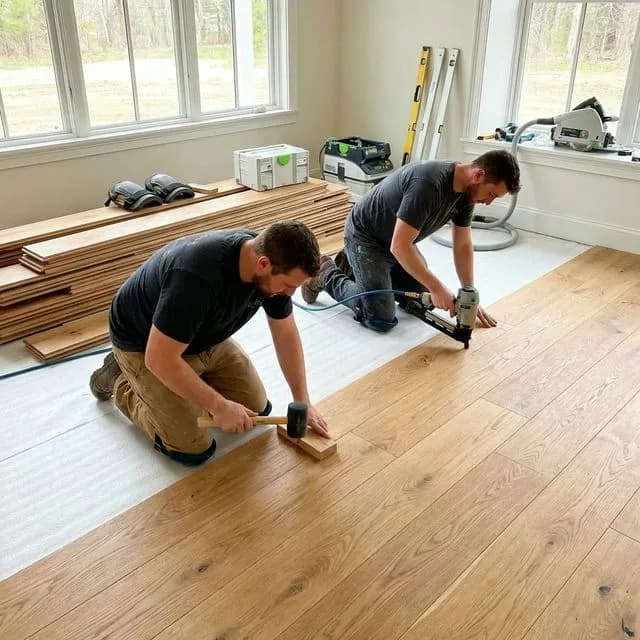
If there is one thing I have learned from seven years of in-home flooring consultations, it is this: the right flooring choice can make a small room feel significantly larger, and the wrong choice can make it feel like a closet. I am not exaggerating. I have seen 10-by-10 bedrooms in Allentown Cape Cods that felt open and airy after a flooring change, and I have seen 12-by-14 living rooms in North Jersey condos that felt cramped because the flooring was working against the space instead of with it.
I'm Jen Kowalski, a CFI-certified design consultant at VM Power Flooring. I work across Pennsylvania and New Jersey helping homeowners make design decisions that transform their spaces. Small rooms are something I deal with constantly — the housing stock in our market includes a lot of post-war Cape Cods, row homes in Allentown and Bethlehem, narrow NJ condos, and split-levels with compact bedrooms. These are real homes with real spatial constraints, and flooring is one of the most powerful tools for making them feel bigger without knocking down a single wall.
This guide covers everything I know about using flooring to visually expand small spaces. We are talking about plank direction, color psychology, pattern scale, material choices, and specific product recommendations. Whether you are renovating a small bathroom, a narrow hallway, a compact bedroom, or an entire floor of a smaller home, the principles here will help you make choices that open things up. Let me walk you through it.
Why Flooring Choice Makes or Breaks a Small Room
In a large, open-concept great room, your flooring choice has a lot of margin for error. You can get away with dark colors, busy patterns, or narrow planks because the sheer size of the space absorbs the visual impact. A small room does not give you that luxury. Every design decision is amplified in a tight space — and flooring is the single largest surface in the room.
Think about it proportionally. In a 10-by-12 bedroom, the floor is 120 square feet of uninterrupted surface. The walls might total 350 square feet, but they are broken up by a door, a window, a closet, and furniture pushed against them. The floor is the one surface you see in its entirety. It sets the visual tone for how big or small the room feels before anything else registers.
I worked with a homeowner in Bethlehem last fall who had a 1940s Cape Cod with original dark-stained red oak throughout. The bedrooms upstairs were small — roughly 10 by 11 with sloped ceilings — and they felt almost oppressive. We refinished the floors with a natural stain and matte water-based finish, and the difference was remarkable. The rooms looked the same on paper, but they felt completely different. The homeowner said it felt like moving into a different house. That is the power of getting the floor right in a small room.
At VM Power Flooring, we have a team of 35+ professionals and we have worked on thousands of homes across PA and NJ since 2003. A significant percentage of those projects involve smaller rooms and older homes where space is at a premium. Our owner, Vincent Karaca, built this company on the principle that every room deserves professional attention, not just the big showcase spaces. Some of the most impactful transformations we have done have been in bedrooms, hallways, and bathrooms under 80 square feet.
The principles that make small rooms feel bigger are well-established in interior design, and they apply directly to flooring. Light colors reflect light and push walls outward. Continuous surfaces without visual breaks make spaces feel connected and larger. Running planks in the right direction elongates or widens a room. Minimal pattern variation keeps the eye calm and the space uncluttered. Let me break each of these down with the specifics that actually matter when you are standing in a flooring showroom or looking at samples in your home.
Light Colors Open Up a Space (The Science Behind It)
This is not just a design opinion — it is rooted in how human vision works. Light-colored surfaces reflect more ambient light back into the room, which makes walls appear farther apart and ceilings appear higher. Dark surfaces absorb light, which creates a sensation of enclosure. Interior designers have understood this for centuries, and it is why small rooms in European palaces were often painted in pale pastels with light-colored marble floors — even hundreds of years ago, designers knew how to manipulate spatial perception with color.
In flooring terms, this means that a natural white oak floor or a light ash-toned luxury vinyl plank will make a small room feel measurably more open than a dark jacobean stain or an espresso-toned LVP. I see this play out in real homes every week. The row homes in Allentown and Bethlehem that we work on frequently have small living rooms and bedrooms — typically 10 to 12 feet in one dimension. When these rooms have dark floors, they feel like they are closing in on you. When we switch to a light or medium-light tone, the same room opens up dramatically.
The specific colors I recommend most often for small rooms are natural white oak with a clear water-based finish, Duraseal Golden Pecan on white oak, or a light natural-oak LVP like COREtec Sparrow or Shaw Floorte Pro in a warm oak colorway. These are all in the light to medium-light range, they reflect light well, and they have warm undertones that keep the room feeling inviting rather than clinical.
Color Temperature Matters Too
It is not just about light versus dark. The warmth or coolness of the color affects spatial perception as well. Warm tones — golds, honeys, natural wood tones — tend to feel inviting and approachable. Cool tones — grays, blue-undertone whites — can feel slightly more expansive in theory, but they also risk feeling cold and sterile in a small room that already lacks natural light.
In my experience across hundreds of small-room consultations, warm light tones outperform cool light tones almost every time. A small bedroom in a NJ condo with a warm natural oak floor feels open and cozy. The same room with a cool gray-washed floor feels open but also slightly impersonal and flat. Warmth gives a small room soul, and you need soul when you do not have square footage.
There is also a practical consideration: most homes in Pennsylvania and New Jersey have warm-toned lighting — either incandescent bulbs or warm LED bulbs in the 2700K to 3000K range. Warm-toned floors look their best under warm lighting because the tones reinforce each other. A cool gray floor under warm lighting can look washed out or slightly muddy. This is one of the reasons the gray flooring trend has faded so quickly in our market — it simply does not look as good in real home lighting conditions as it does in a showroom with neutral-temperature LEDs.
What About Medium Tones?
Medium tones like Duraseal Provincial or Special Walnut can absolutely work in small rooms, especially if the room has decent natural light and light-colored walls. Provincial on white oak, for example, creates a warm amber glow that makes a small room feel cozy without feeling cramped. It is darker than natural but nowhere near heavy enough to shrink the space. I have used provincial in small bedrooms in PA colonials many times with excellent results.
The general rule: in a small room, you can go up to medium on the darkness scale without losing the sense of openness, as long as the walls are light and there is some natural light coming in. Beyond medium — into the special walnut, jacobean, and ebony territory — you start losing visual space in a way that is hard to compensate for with other design choices.
Wide Planks in Small Rooms: Yes, It Works
This is one of the most common misconceptions I encounter: the idea that wide planks are only for large rooms and that small rooms need narrow strips. I hear it from clients constantly, and I understand the intuition — it feels like a wide plank would overwhelm a small space. But the reality is exactly the opposite, and once I explain why, it clicks for every homeowner I work with.
Think about what happens visually when you install narrow 2.25-inch strip flooring in a small room. You are introducing dozens and dozens of seams across that 120-square-foot floor. Each seam is a visual interruption — a line that the eye registers, even subconsciously. All those lines create busyness. Busyness in a small space equals visual clutter, and visual clutter makes a room feel smaller and more chaotic.
Now consider a 7-inch or 9-inch wide plank in that same room. Instead of dozens of seams, you have far fewer. The floor reads as a calmer, more unified surface. Your eye flows across it without constant interruption. That visual calm translates directly into a sense of spaciousness. The room feels less busy, less cluttered, and therefore larger.
I installed 9-inch wide white oak planks in a small bedroom in a row home in Allentown last year — the room was about 10 by 11 feet. The homeowner was initially hesitant about the wide plank because she thought it would look out of proportion. After installation, she called it the best design decision she made in the entire renovation. The floor looked intentional and sophisticated, and the room felt calmer and more spacious than it had with the original narrow strip oak.
The Math Behind Wide Planks
Here is a concrete comparison. In a 10-by-12 room (120 square feet), 2.25-inch strip flooring installed across the 10-foot dimension creates approximately 53 plank rows visible across the width of the room. A 7-inch wide plank in the same dimension creates about 17 rows. That is a reduction from 53 visual lines to 17 — a dramatically cleaner, more open look. At 9 inches wide, you are down to about 13 rows. The fewer the visual lines, the larger the room feels.
In the LVP world, wide planks are the standard now, which is one of the reasons luxury vinyl plank looks so good in small spaces. Most premium LVP products — COREtec Plus, Shaw Floorte Pro, Mohawk RevWood Premier — come in 7-inch to 9-inch widths. When we install these in compact NJ condos or small PA bedrooms, the visual effect is consistently impressive. The floor feels expansive even when the room is not.
Plank Length Matters Too
Longer planks further reduce the number of end joints visible across the floor. Short planks create a grid-like pattern of seams that makes the floor look busier. Many premium hardwood and LVP products now offer random-length planks up to 72 inches or longer, and the visual difference in a small room is noticeable. When I spec flooring for a small space, I always look for products with longer average plank lengths. COREtec Plus Enhanced planks, for example, run about 48 inches long, while some engineered hardwood options run 72 inches or more. Those extra inches reduce visual interruptions and contribute to a feeling of openness.
The Best Flooring Direction for Small Rooms
Plank direction is one of the most impactful decisions you can make in a small room, and it is also one of the most debated. I have a clear position on this, based on hundreds of installations in small spaces across PA and NJ: run the planks parallel to the longest wall in the room. This is the single most effective directional trick for making a small room feel larger.
Here is why it works. When planks run lengthwise — along the long dimension of a rectangular room — the lines created by the plank edges draw the eye along the longest available sight line. Your brain registers that extended line and interprets the room as longer than it might feel otherwise. It is the same principle that makes vertical stripes on clothing create a lengthening effect. The eye follows the line, and the perceived dimension stretches.
Running planks perpendicular to the longest wall — across the short dimension — does the opposite. It emphasizes the shorter dimension and creates a series of lines that visually chop the room into narrow bands. In a bedroom that is 10 feet wide and 12 feet long, running planks across the 10-foot width makes the room feel even narrower than it is. Running them along the 12-foot length makes that same room feel extended and more proportional.
The Hallway Rule
In narrow hallways — and the hallways in PA row homes and NJ condos are notoriously narrow — always run planks along the length of the hallway. This is non-negotiable in my book. A narrow hallway with planks running crosswise looks like a ladder. It is visually jarring and makes the space feel even tighter. Planks running lengthwise create a runway effect that draws the eye forward and makes the hallway feel like a passage rather than a box.
I worked on a 1960s split-level in Morristown where the upstairs hallway was barely 36 inches wide and about 18 feet long. The previous flooring was tile set in a pattern that ran crosswise. It felt like walking through a tunnel. We replaced it with 7-inch wide LVP planks running lengthwise, and the hallway suddenly felt like an intentional part of the home rather than a cramped afterthought. The homeowner said guests commented on how much bigger the upstairs felt, even though we only changed the hallway floor.
What About Diagonal Installation?
Diagonal installation — running planks at a 45-degree angle to the walls — is an interesting option for small rooms, and it can work very well in certain situations. The theory is sound: a diagonal layout creates the longest possible sight lines in a room because the longest line in a rectangle runs from corner to corner. In a 10-by-12 room, the diagonal is about 15.6 feet — longer than either wall dimension.
In practice, diagonal installation works best in roughly square rooms where running planks parallel to any wall would emphasize one short dimension or another. In a 10-by-10 bedroom or a square entryway, a diagonal layout creates dynamic visual interest without favoring one direction. It makes the room feel lively and slightly larger because of those extended corner-to-corner lines.
The downsides of diagonal installation are practical: it requires more material — typically 10 to 15 percent more than a straight install due to the angled cuts at the walls — and it takes longer to install, which means higher labor costs. For most budgets, running planks parallel to the longest wall gives you 90 percent of the spatial benefit at a lower cost. I recommend diagonal primarily for entryways, mudrooms, and roughly square rooms where the standard parallel layout would not have a clear directional advantage.
Continuity Across Rooms
One of the most powerful things you can do for small rooms is to run the same flooring in the same direction through adjacent spaces without transition strips. When the floor continues unbroken from a hallway into a bedroom or from a living room into a dining room, the eye reads both spaces as one larger area. The visual boundary between rooms dissolves, and the smaller room borrows perceived space from the larger one.
This is particularly effective in the smaller homes we work on throughout the Lehigh Valley and North Jersey. A 1,200-square-foot Cape Cod with continuous flooring throughout the first floor feels significantly larger than the same house with different flooring in every room and transition strips at every doorway. Vincent Karaca, our owner, emphasizes this to every client: continuity is one of the most cost-effective ways to make a small home feel bigger, and it costs nothing extra during installation. You are simply choosing not to interrupt the floor.
Pattern and Layout Tricks That Add Visual Space
Beyond plank direction and width, the pattern and layout of your flooring affects how spacious a room feels. This is where design knowledge separates a good installation from a great one, and it is something I spend a lot of time discussing during consultations for smaller homes.
Stagger Pattern
For plank flooring — whether hardwood or LVP — a random stagger pattern looks more natural and less busy than a regular stagger. A regular stagger, where every other row's end joints line up, creates a visible step pattern that the eye picks up on. In a small room, that repetitive pattern adds visual noise. A random stagger, where end joints are offset irregularly, makes the floor look more organic and less patterned. The result is a calmer surface that lets the room breathe.
Our installers are trained to achieve a natural random stagger on every project — minimum six-inch offset between end joints in adjacent rows, with no discernible repeating pattern. In a small room, this attention to detail matters more than it does in a large space because there are fewer planks to look at and any pattern becomes more obvious.
Herringbone and Chevron in Small Spaces
Herringbone and chevron patterns are having a major design moment, and clients frequently ask me about using them in small rooms. My answer is nuanced: it depends on the room and the scale of the pattern.
A large-scale herringbone — using planks that are 5 inches wide and 24 to 30 inches long — can actually look stunning in a small room. The V-shaped pattern creates a sense of movement and visual depth that can make a floor feel more dynamic and interesting. The key is scale. Small-format herringbone, with skinny 2-inch-wide pieces, creates too much visual busyness in a compact space and can make the room feel cluttered rather than elegant.
I recommended a wide-format herringbone in an entryway for a client in Easton last spring — the space was only about 6 by 8 feet. We used 5-inch-wide white oak planks in a herringbone pattern with a natural finish. It made that small entry feel like a deliberate design moment rather than a transitional afterthought. The wide planks kept the pattern from feeling busy, and the natural color kept the space feeling open.
Chevron works similarly. The angled cuts create a cleaner V than herringbone, and the continuous zigzag lines can draw the eye along the length of a room. Like herringbone, wider planks work better in small spaces. Both patterns require more material and more skilled labor than a standard plank installation, so budget accordingly.
Tile Patterns for Small Floors
In small bathrooms and entryways where tile is the preferred material, the same principles apply: larger format, fewer grout lines, simpler patterns. A 12-by-24 or even 24-by-24 tile creates fewer visual interruptions than a mosaic or small-format tile. Every grout line is a visual break, and in a small bathroom, you want as few breaks as possible.
For grout color, match it to the tile as closely as possible. Contrasting grout — like white tile with dark gray grout — highlights every grout line and turns your floor into a grid. That grid effect shrinks the space. Matching grout makes the seams nearly disappear, and the floor reads as a single continuous surface. In a small powder room or bathroom, this single choice can make a surprising difference in how spacious the room feels.
Best Materials for Small Bathrooms, Entryways, and Closets
Small rooms come in different forms, and the best flooring material varies depending on the room's function and moisture exposure. Here is what I recommend for the specific small spaces I encounter most often in PA and NJ homes.
Small Bathrooms
Small bathrooms are the trickiest small spaces because you need waterproof performance in addition to visual expansion. The days of vinyl sheet flooring as the only bathroom option are long gone. Today, the best option for most small bathrooms is a high-quality luxury vinyl plank or tile. LVP is 100 percent waterproof, installs without grout lines (which helps the floor read as a continuous surface), and comes in the warm, light oak tones that work best in small spaces.
For a small bathroom — anything under 50 square feet — I typically recommend a 7-inch wide plank LVP in a light warm tone. COREtec Plus in a natural oak or Shaw Floorte Pro in a light maple are both excellent choices. The wide plank, warm color, and seamless surface combine to make the bathroom feel as open as possible. Run the planks lengthwise — parallel to the longest wall — and continue them right up to the vanity and tub without transition strips.
If the homeowner prefers tile, I recommend large-format tile — 12 by 24 at minimum, 24 by 24 if the room can accommodate it — in a light, warm-neutral color. Rectified tile with thin grout lines and color-matched grout will minimize visual interruptions. Avoid mosaic tile on the floor of a small bathroom. Mosaics look beautiful as accents, but on the floor they create a visually busy surface that shrinks the space.
Entryways and Foyers
Many PA and NJ homes — particularly the colonials and Cape Cods built between 1940 and 1970 — have small entryways. Sometimes it is just a 3-by-5 landing inside the front door. These tiny spaces set the tone for the entire home, so the flooring choice matters disproportionately.
My recommendation for small entryways: match the adjacent flooring material. If the living room has hardwood, continue the hardwood right into the entryway. If the main living area has LVP, extend it through the entry. This eliminates the transition strip at the entry threshold and makes the foyer feel like part of the larger space rather than a separate little box.
If durability concerns demand a different material in the entry — and this is valid, especially in PA winters with road salt and wet boots — choose a material and color that closely matches the adjacent floor. A warm-toned porcelain tile that echoes the color of the LVP or hardwood in the next room will maintain visual continuity even with a material change. Use a low-profile transition strip in a matching color to make the seam as subtle as possible.
Walk-In Closets
Walk-in closets are an overlooked opportunity. Many homeowners default to carpet in closets, but I encourage them to continue the bedroom flooring into the closet. When the closet floor matches the bedroom floor, the closet reads as an extension of the bedroom rather than a separate space. With the closet door open, the eye flows from bedroom to closet without interruption, and both spaces feel larger.
This is especially impactful in smaller master bedrooms — common in 1950s and 1960s homes throughout Allentown, Bethlehem, and Easton — where the walk-in closet might be just 5 by 6 feet. Continuing a wide plank hardwood or LVP from the bedroom into the closet visually annexes that closet space and makes the bedroom feel more generous. It also eliminates the awkward carpet-to-hardwood transition at the closet doorway, which always looks like an afterthought.
Laundry Rooms and Mudrooms
These are high-moisture, high-traffic small spaces that need durable, waterproof flooring. LVP is the clear winner here. A 7-inch wide plank in a warm tone — something that coordinates with the adjacent hallway or kitchen flooring — keeps the visual flow going while handling the practical demands. In a mudroom that opens to a hallway, continuing the same LVP from one space to the other makes both areas feel more expansive.
For mudrooms specifically, I recommend an LVP with an enhanced scratch and wear layer — Shaw Floorte Pro with a 20-mil wear layer or COREtec Plus Enhanced. These products handle the abuse of boots, pet nails, and tracked-in debris without showing wear, and they clean up with a simple mop. The practical performance in these small, hardworking rooms is just as important as the visual strategy.
What to Avoid in Small Spaces
I have spent the last several sections talking about what works. Now let me tell you what does not — because avoiding common mistakes is just as important as making good choices. These are the flooring decisions I actively steer clients away from in small rooms, based on years of seeing what goes wrong.
Avoid Very Dark Stains and Colors
I have mentioned this throughout the guide, but it bears repeating with emphasis. Jacobean, ebony, true black, and very dark espresso tones shrink small rooms visually. They absorb light instead of reflecting it, they make the walls feel like they are closing in, and they turn a compact room into a cave-like space. I have seen it happen in Cape Cod bedrooms in the Lehigh Valley, in narrow NJ condo kitchens, and in small dining rooms throughout our market. If the room is under 150 square feet and lacks abundant natural light, dark floors are a significant risk.
The one exception: a small room that is deliberately designed as a dark, moody space — a powder room with dramatic wallpaper and dark fixtures, for example. In that case, a dark floor is part of a deliberate design scheme, not an oversight. But that is a very specific design choice, not a general strategy.
Avoid High-Gloss Finishes
This might seem counterintuitive — would not a glossy floor reflect more light? In theory, yes. In practice, high-gloss floors in small rooms create harsh reflections and visible imperfections that make the space feel smaller and less comfortable. Every scratch, every dust particle, every scuff mark is amplified on a glossy surface. The floor becomes a distraction rather than a calm backdrop.
Matte and satin finishes are far better for small rooms. They reflect light softly and evenly, they hide minor imperfections, and they create a more relaxed visual texture. Every hardwood refinishing project we do in a small room gets a matte or satin water-based finish recommendation from me. It is the smarter choice for both aesthetics and maintenance.
Avoid Multiple Flooring Materials in Connected Spaces
This is one of the biggest spatial mistakes I see in older PA and NJ homes. The hallway has one floor. The bedroom has another. The bathroom has a third. Each transition creates a visual boundary that makes every room feel smaller and more isolated. In a small home, those boundaries add up fast.
When we do whole-floor or whole-house installations, I always advocate for material continuity. One floor, one direction, running through every space that shares the same floor level. Transition strips only where absolutely necessary — at the threshold to a bathroom or at a material change between a wet area and a dry area. Every transition strip you eliminate makes the connected spaces feel larger.
Avoid Busy Patterns and Heavy Grain Variation
A floor with extreme grain variation — wide swings between light sapwood and dark heartwood, heavy knots, dramatic character marks — creates a lot of visual activity. In a large room, that character adds interest. In a small room, it adds clutter. The eye does not have enough space to process the pattern without feeling overwhelmed.
For small rooms, I recommend select or premium grade hardwood with more consistent grain, or an LVP with moderate, realistic variation. You still want the floor to look like natural wood — completely uniform looks read as artificial — but the variation should be subtle rather than dramatic. COREtec's naturals line strikes a good balance between realism and visual calm, and it is what I recommend frequently for small-space LVP installations.
Avoid Narrow Strip Flooring
I covered this in the wide plank section, but listing it again here as an explicit avoid. The 2.25-inch strip oak flooring that was standard in homes built between 1940 and 1980 creates too many visual seams in a small room. If you are renovating and the budget allows, replacing narrow strip flooring with wider planks is one of the most impactful upgrades you can make in a compact bedroom, hallway, or living room.
Avoid Contrasting Borders and Inlays
A decorative border around the perimeter of a room — a dark walnut border around a lighter field, for example — draws attention to the room's edges and highlights its dimensions. In a large dining room or foyer, a border can look elegant. In a small room, it is a frame that says "look how small this space is." Keep the floor continuous and unframed in small spaces. Let it run wall to wall without decorative interruptions.
Frequently Asked Questions
What direction should I lay flooring in a small room?
Run the planks lengthwise — meaning parallel to the longest wall in the room. This draws the eye along the longest dimension and makes the room feel more expansive. In narrow hallways or galley kitchens, always run planks along the length, never across the width. Diagonal installation at 45 degrees is another option that can make a small room feel larger by creating longer visual sight lines from corner to corner, though it requires more material and more cutting. If possible, continue the same plank direction through adjacent rooms to maximize the sense of flow and openness.
What is the best flooring color for a small bathroom?
Light and warm-neutral tones work best in small bathrooms. A light oak-look LVP, warm beige tile, or soft natural stone visual opens the space and reflects the limited light most bathrooms have. Avoid very dark floors in small bathrooms — they absorb light and make an already tight space feel even smaller. If the bathroom has no window, a lighter floor is especially important. For tile, go with large formats — 12 by 24 or bigger — with color-matched grout to minimize visual interruptions on the floor.
Should I use wide or narrow planks in small rooms?
Wide planks — 7 inches or wider — work very well in small rooms despite what many people assume. Fewer planks mean fewer seams, and fewer seams mean the floor reads as a more unified surface. This visual continuity makes the room feel larger. Narrow strip flooring with lots of seams can make a small room feel busy and cluttered. A 7-inch or 9-inch wide plank LVP or hardwood creates a calm, open look even in rooms under 100 square feet. Keep the plank width consistent throughout the home so the eye flows from room to room.
Does dark flooring make a room look smaller?
Yes, dark flooring generally makes a room look and feel smaller. Dark colors absorb light rather than reflecting it, which makes walls feel closer together and ceilings feel lower. In a small room with limited natural light — like many of the bedrooms and hallways in older PA and NJ homes — a dark floor like jacobean or ebony stain can make the space feel cramped. You can partially offset the effect with light walls, abundant lighting, and light furniture, but the room will still feel tighter than with a light or medium-toned floor. For small spaces, stick with natural, golden pecan, or provincial stains on hardwood, or a light oak LVP.
What is the best flooring for a narrow hallway?
For narrow hallways, run planks lengthwise down the hall to elongate the space visually. Choose a light to medium color in a wide plank format with minimal texture variation. LVP is often the best material choice for hallways because it handles heavy foot traffic, resists scratches, and installs seamlessly without transition strips between rooms. Shaw Floorte Pro or COREtec Plus in a warm oak tone, installed lengthwise in 7-inch or wider planks, is one of the most effective combinations. Continue the same floor from the hallway into the adjacent rooms whenever possible to eliminate transitions that visually chop the space.
Should small rooms have the same flooring as the rest of the house?
Yes — using the same flooring throughout the home, including small rooms, is one of the most effective ways to make those rooms feel larger. When the floor continues unbroken from a larger space into a smaller one, the eye reads them as a single continuous area rather than separate boxes. Transition strips between rooms create visual breaks that emphasize where one room ends and another begins, making small rooms feel more contained. If you must use a different material in a small room — tile in a bathroom, for example — choose a color that closely matches the adjacent flooring to maintain visual flow. Schedule a consultation and we can help you plan a cohesive whole-house flooring strategy that makes every room feel connected and spacious.
Explore Our Related Services
About the Author
Design Consultant
Certified: CFI
Jen handles in-home consultations and helps homeowners pick the right floor for their space, budget, and lifestyle. She came from the interior design side — seven years at a kitchen-and-bath firm in B...
You Might Also Like
How to Choose Flooring Color: A Design Consultant's Complete Guide
Flooring color sets the tone for your entire home. Here's how to choose between light and dark, warm and cool — plus the...
Read: How to Choose Flooring Color: A Design C… DesignOpen Concept Flooring Ideas: How to Choose One Floor for Your Whole Main Level
Open floor plans need one flooring choice that works everywhere — kitchen, living room, dining room, and hallways. Here'...
Read: Open Concept Flooring Ideas: How to Choo… TrendsTop Flooring Trends for 2026: What Homeowners Are Choosing
Pinterest boards are one thing. What homeowners actually pick when they're spending real money is another. Here's what w...
Read: Top Flooring Trends for 2026: What Homeo…